
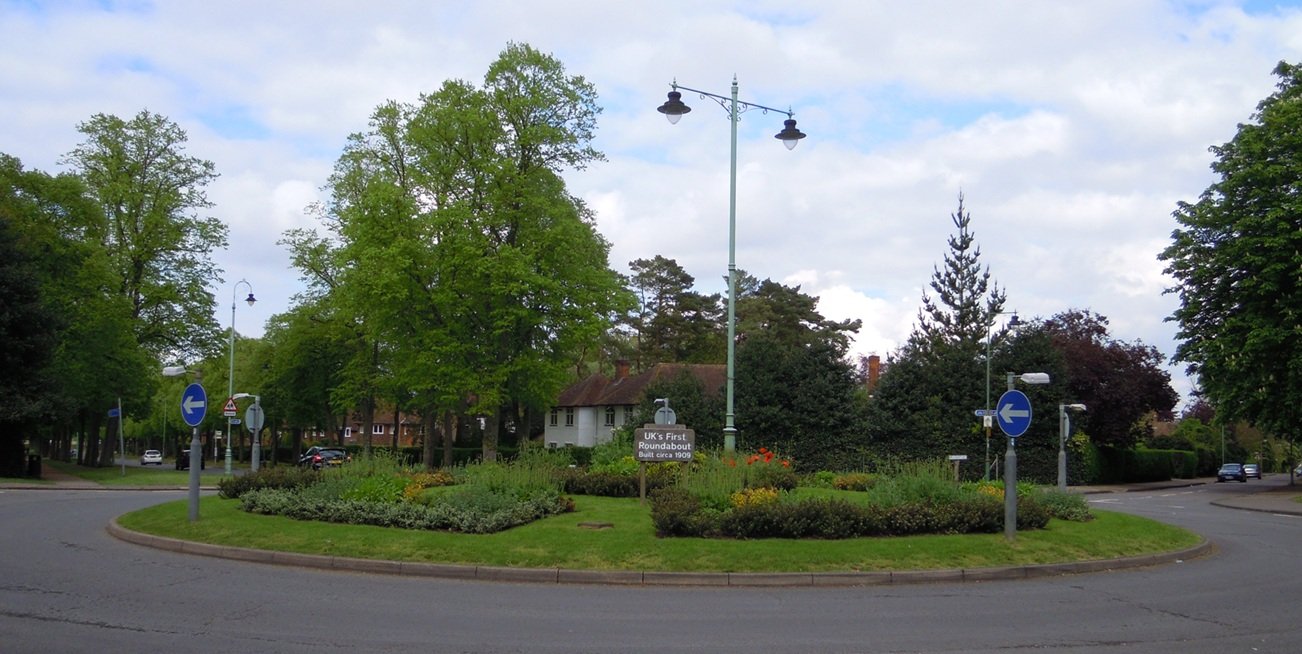
Blackmore, the 1966 Give-Way Rule, and Speed-Controlling Geometry
Part 2 of 8 | Approximately 12 minutes
Part 1 followed circular intersections from monumental city spaces and horse-drawn turnabouts to the large traffic circles and rotaries of the early automobile era. Those intersections introduced one-way movement around a central island, but they did not consistently solve the questions of priority, speed, and weaving.
The development that created the modern roundabout took place in Britain during the 1960s. It involved more than making the entering drivers to yield. Researchers and designers also changed the size and shape of the intersection so that drivers approached more slowly, met circulating traffic at a manageable angle, and followed a more predictable path.
Frank Blackmore played a central role in that work at Britain’s Road Research Laboratory. He did not invent circular traffic movement, and calling him the inventor of the roundabout would erase more than half a century of earlier history. His documented contribution was more specific: he helped develop and test the operating and geometric ideas that turned the older circular intersection into what we recognize as a modern roundabouts today.
In This Series
- Before the Modern Roundabout
- The Modern Roundabout Is Born ← You are here
- From the Laboratory to the Street
- Crossing the Atlantic
- How Roundabout Design Evolved
- Designing for People Outside the Vehicle
- How Roundabouts Are Evaluated and Chosen
- Roundabouts Today
In This Part
- The limitations of the original priority rule
- Frank Blackmore and the Road Research Laboratory
- What actually changed in 1966
- Moving the queue outside the circle
- Why the priority rule was not enough
- Why smaller did not mean as small as possible
- How geometry began controlling driver behavior
The limitations of the original priority rule
As described in Part 1, the basic problem was that if entering vehicles can claim priority over circulating vehicles, a busy approach can interrupt the entire circle. Drivers already inside the intersection may be unable to pass the busy entry, while they must actually pass it to reach their exits.
The resulting queue forms inside the intersection instead of the approach which is intended to hold waiting vehicles. If the queue inside the circle reaches another entry, it prevents that approach from moving. The blockage can then spread backward around the circle and into the other approaches.
British engineers described this condition as locking. The intersection appeared to provide continuous movement, but its priority arrangement could bring movements to a stop.
The FHWA’s historical account explains that this problem was not limited to Britain. As traffic volumes increased, circular intersections in several countries experienced congestion and lock-up. Making the circles larger did not necessarily solve the problem because the problem of priority remained.
In some cases, a larger circle made other problems worse. Drivers had more room to enter at speed, more distance inside the circle to change lanes, and more opportunities to weave across one another’s paths.
The solution was simple: entering drivers should wait for a gap while vehicles already inside the circle continued moving. In practice, however, changing a national operating rule required research, testing, road markings, public communication, and a better understanding of how the new priority arrangement would affect capacity and safety.
Frank Blackmore and the Road Research Laboratory
Frank Blackmore joined Britain’s Road Research Lab in 1960 and worked there until 1981, by which time it had become the Transport and Road Research Laboratory. According to his 2008 obituary in The Guardian, he became deeply involved in the study of junction design, roundabout priority, and the development of compact roundabouts.
Blackmore is sometimes described as the inventor of the roundabout. That description is not historically accurate. Circular junctions existed long before his work, and one-way gyratory traffic systems had been introduced in Paris and New York near the beginning of the 20th century.
However, Blackmore’s contribution concerned the transformation of that older idea, so maybe we could say he was the original ideator of the “modern roundabouts.” The Transportation Research Board’s TRID record for Priority at Roundabouts documents a paper by Blackmore published in October 1962. Its subjects include right of way, traffic flow, capacity, travel time, and traffic signs.

The records show that priority was being studied several years before the national change in 1966. Researchers were not merely considering which driver should go first. They were examining how the rule affected the amount of traffic that could enter, how queues developed, and how the physical layout influenced driver behavior.
Blackmore’s later report, Capacity of Single-Level Intersections, published by the Road Research Laboratory in 1970, describes full-scale experiments conducted on a test track and at public intersections. The report examined traffic signals, conventional roundabouts, different island sizes, entry layouts, and what it called the “priority-from-right” rule.
In Britain, where vehicles travel on the left side of the road and circulate clockwise around a roundabout, entering drivers give way to traffic approaching from their right. In the United States, vehicles circulate counterclockwise, so entering drivers yield to circulating traffic approaching from their left. The direction changes, but the operating principle is the same: traffic already circulating has priority.
What actually changed in 1966
Later engineering histories commonly describe November 1966 as the point when Britain adopted a mandatory give-way rule at roundabouts. The FHWA’s document states that the United Kingdom adopted a mandatory rule requiring entering traffic to yield to circulating traffic.
Contemporary British government records use more careful language. On November 2, 1966, the British government announced that a “general advisory rule” would be introduced. Under that rule, vehicles entering a roundabout were to give way to vehicles already inside it.
The government also stated that roundabout entries would be marked with single broken white lines. Upright give-way signs would not be required at every entry because the new arrangement was intended to operate as the general rule. Exceptions could be made, but those exceptions were to be shown through different road markings.

A later House of Commons answer, dated February 22, 1967, addressed the legal question directly. The government stated that the give-way rule was advisory and “not imposed by regulations”.
Both descriptions should remain in the historical record:
- FHWA guidance describes the 1966 change as a mandatory give-way rule.
- Contemporary British Parliamentary records describe it as a general advisory rule supported by entry markings and explicitly state that it was not imposed by regulation.
Either way, the most important and defensible description is that Britain established a general national expectation in November 1966 that entering traffic would give way to circulating traffic. Operationally, this was the turning point later histories identify with the birth of the modern roundabout.
Now, drivers approaching roundabouts throughout the country were being given a consistent instruction. The road markings also made the point of entry more visible and identified where the yielding decision should occur.
Moving the queue outside the circle
The give-way rule changed more than the order in which two drivers moved. It also changed where delay occurred.
When an entering driver could not find a suitable gap, that driver waited on the approach. Vehicles already inside the roundabout could continue toward their exits. The queue therefore remained outside the circulating roadway instead of developing inside it and blocking other movements.
This also made the relationship between entering traffic and circulating traffic easier to study. As the amount of circulating traffic in front of an entry increases, the number of acceptable gaps generally decreases. Fewer vehicles can enter during the same period, and the entry’s capacity falls.
Modern capacity methods are far more detailed, but this relationship remains central to roundabout analysis today. Traffic on one approach is not evaluated by itself. Its ability to enter depends heavily on the circulating flow it must cross or join.
The 1966 change therefore created a more structured operating system. It did not, by itself, create a safe or effective modern roundabout.
The priority rule was not enough
Placing a give-way line across a fast, nearly straight approach does not automatically produce a low-speed intersection. A driver may still reach the entry too quickly, misjudge a gap, or treat the movement like a high-speed merge. The FHWA’s account of the British development connects the priority change with another important step: the proposal of smaller circular intersections with enough horizontal curvature to reduce entry and circulating speeds.
Blackmore’s 1970 Road Research Laboratory report provides more detail. Its experiments found that, under the priority-from-right system, high capacity could be achieved using a relatively small central island and a marked deflection of entering traffic.
The word deflection sounds more complicated than it is. It means that the driver cannot continue straight through the entry at normal road speed. The approach directs the vehicle toward the central island (turning left a tiny bit first, aka offset-left before turning right at the approach and yield point) and then requires the driver to turn around it.
That curved path serves several purposes:
- It lowers the speed at which the driver reaches circulating traffic.
- It turns the driver toward the direction from which circulating vehicles are approaching.
- It makes the entry into the roundabout visually and physically distinct from continuing along an ordinary road.
- It reduces the likelihood that the driver will treat the entry as a fast merge.
This was a major break from many old rotaries. Older designs frequently used large central islands and approaches that joined the circulating roadway at shallow, nearly tangent angles. Those layouts could encourage speed because a driver did not have to make a noticeable turn before entering.
The new approach did not rely only on a sign telling the driver to slow down. The road itself made a slower path necessary.
Smaller did not mean “as small as possible”
Blackmore’s experiments showed that a very large central island was not always needed to organize traffic. In certain layouts, the entry deflection (offset-left) could perform much of the work previously assigned to the island.
However, the research did not establish that the smallest island would always be best. The 1970 report noted that reducing the island without providing proper entry deflection could create congestion close to the center. Drivers could have difficulty following the priority rule or understanding the intended path. The report concluded that a suitable entry deflection was necessary if a very small island was used.
This is an important point because the history is sometimes simplified into the idea that Britain merely replaced large circles with small circles. Size was only one part of the change. A successful design had to coordinate:
- The size and position of the central island
- The angle and curvature of the entry
- The width available to entering vehicles
- The path vehicles followed through the intersection
- The speed at which drivers reached each conflict point
- The ability of buses and trucks to complete their movements
A smaller roundabout could use space more efficiently, but only if the road clearly guided drivers through it.
Geometry that explains itself
The most lasting idea from the British work may be that the physical design should produce the behavior the intersection requires.
A speed-limit sign asks a driver to choose a lower speed. A curved approach makes that lower speed necessary. A give-way instruction tells the driver who has priority. A properly positioned entry also turns the driver toward the circulating traffic that must be observed. The driver therefore receives the same message from the rule, the markings, and the shape of the road.
This philosophy remains visible in current American guidance. Chapter 9 of the 2023 NCHRP Guide for Roundabouts treats geometric design as a process of checking actual performance. Designers examine the fastest reasonable path a vehicle could take through the roundabout rather than relying only on a posted or intended speed.
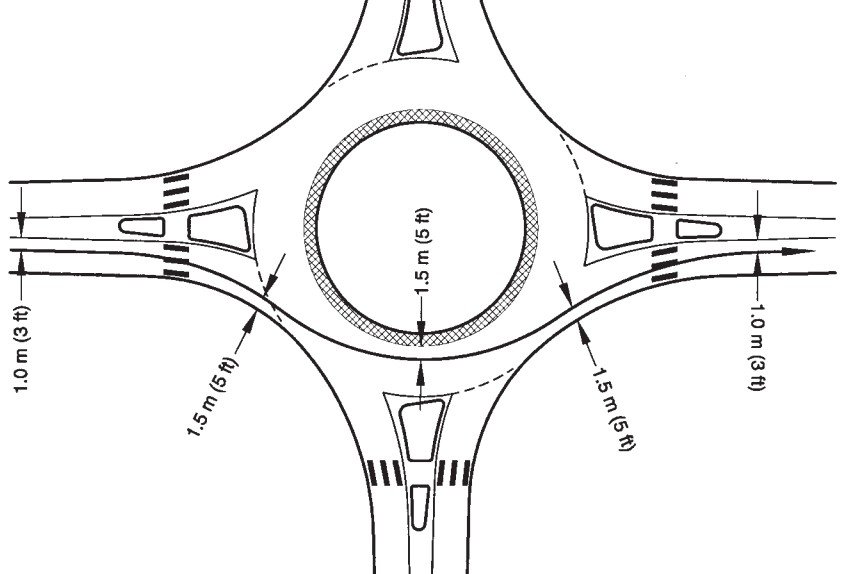
They also examine the relationship between entry speed, circulating speed, and exit speed. A roundabout should not force one extremely sharp movement while allowing the next movement to be much faster. The connected path through the intersection matters more than any single curve considered by itself.
The current guide does not attribute every modern design check directly to Blackmore or the 1960s research. The historical connection is an inference from comparing the earlier British work with later design guidance. However, the common principle is clear: roundabout geometry is used to manage speed and driver paths instead of leaving those results entirely to signs and driver judgment.
By this point, the two basic parts of the modern roundabout had come together. Entering traffic gave way to circulating traffic, and the geometry supported that rule by controlling speed and guiding the driver’s path. The next stage was to test how far those principles could be taken, including if a roundabout could work at intersections too constrained for a conventional central island.

That next stage produced the mini-roundabout and a series of public-road experiments in Britain. Those developments are covered in Part 3.
← Previous: Part 1, Before the Modern Roundabout
Leave a Reply