
Traffic Circles, Rotaries, and the Problem of Priority
Part 1 of 8 | Approximately 9 minutes
The roundabout did not begin with the automobile. Long before engineers calculated entry capacity or traced the path of a truck around a central island, cities already used circular spaces to organize streets around monuments, parks, gates, and civic landmarks. Those places looked round, and traffic eventually traveled around them, but that appearance alone did not make them modern roundabouts.
This is where much of the public confusion begins. A large circle in an old city and a compact roundabout built today may share the same basic outline on a map, but in essence they control speed, priority, and vehicle paths in fundamentally different ways. To understand the modern roundabout, we need to begin with the older circular forms and the problems they created.
In This Series
- Before the Modern Roundabout ← You are here
- The Modern Roundabout Is Born
- From the Laboratory to the Street
- Crossing the Atlantic
- How Roundabout Design Evolved
- Designing for People Outside the Vehicle
- How Roundabouts Are Evaluated and Chosen
- Roundabouts Today
In This Part
- Circles before traffic engineering
- The first one-way circular traffic systems
- A circle without a clear rule
- Why early circles gained a poor reputation
- Columbus Circle and the danger of a simple “first”
- What separates the traditions
Circles before traffic engineering
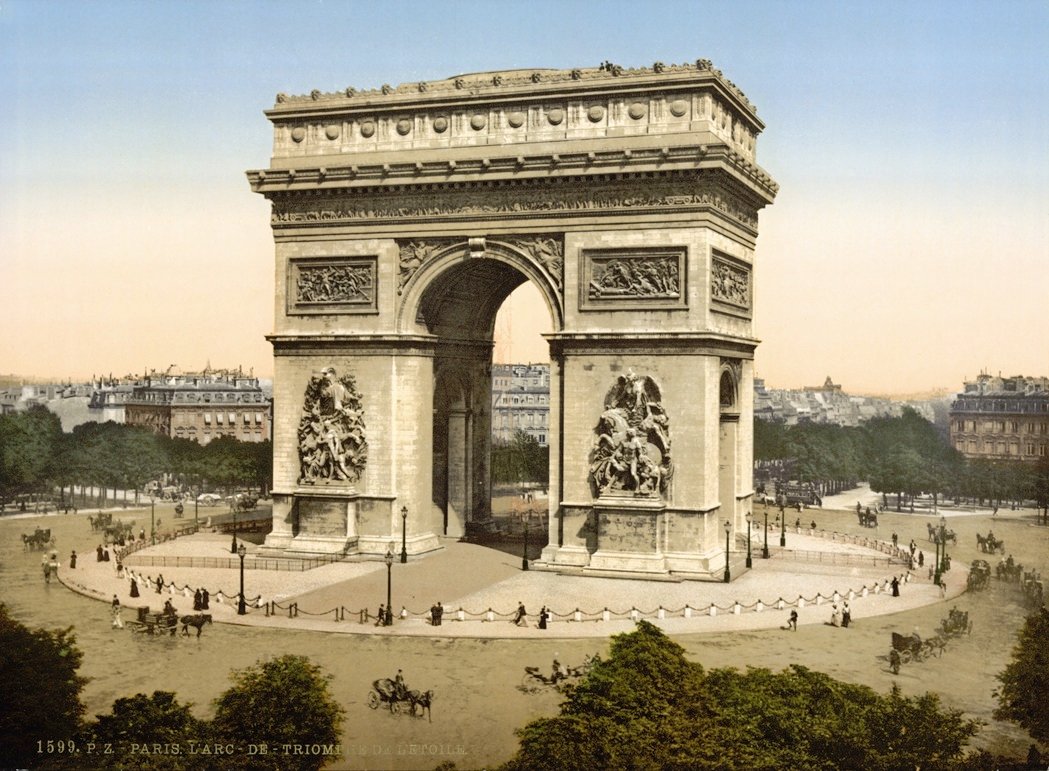
The Place de l’Etoile in Paris, now officially Place Charles-de-Gaulle, stands as one of the best-known examples of a monumental circular space. The French national monument authority’s history of the Arc de Triomphe traces the monument to Napoleon’s 1806 commission, decades before motor vehicles or modern intersection rules existed. The space around the monument did not come from a 20th-century theory of yield control or low-speed geometric design. Instead, it began as a civic and urban form that later had to carry increasingly complex traffic.
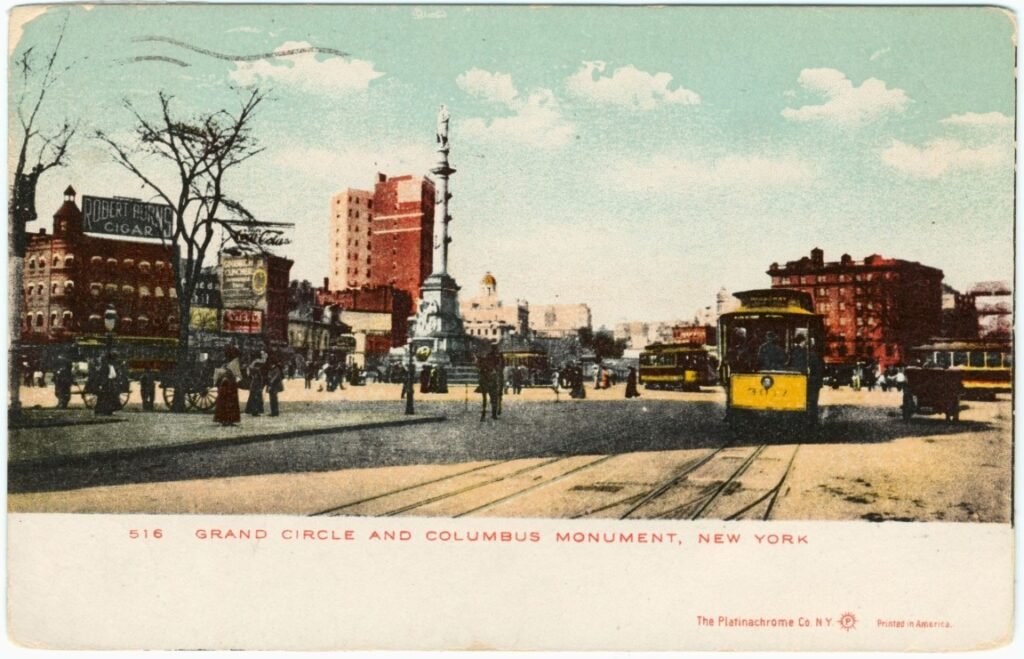
New York’s Columbus Circle has a similarly layered history. The New York City Department of Parks and Recreation states that the city laid out the circular place in 1869 as a turnabout for horse-drawn vehicles. The year 1905, which appears repeatedly in roundabout histories, refers to the early automobile traffic arrangement associated with William Phelps Eno, not to the original creation of the circular space itself.
This may sound like a small historical correction, but it changes how this story reads. Columbus Circle began as a place and a horse-drawn turnabout. It later became an early experiment in organizing automobile traffic into one-way circular movement. Calling it simply “the first roundabout, built in 1905” blends together those separate developments and suggests that a modern roundabout appeared fully formed at the start of the automobile era. It did not.

The first one-way circular traffic systems
At the beginning of the 20th century, growing automobile traffic made it increasingly difficult to cross large open intersections in almost any direction. French planner Eugene Henard proposed what he called a carrefour a giration, or gyratory intersection, in which vehicles circulate in one direction around a central space instead of crossing through conflicting paths.

A transportation-history paper indexed by the Transportation Research Board’s TRID describes Henard’s work at the Place de l’Etoile (Pl. Charles de Gaulle) at the turn of the 20th century. This is where the famous monument Arc de Triomphe exists in the middle of the circle. An Oregon DOT research report, drawing on published roundabout histories, also dates Henard’s concept to 1903, the Columbus Circle traffic system to 1905, and the application of the gyratory concept in Paris to 1907.
The central idea mattered: traffic should move in one direction around an island so that the most direct crossing paths disappear. This marked a meaningful step toward organized circular operation, but it still left several questions unanswered. These were questions that later defined the modern roundabout. Who gets priority when an entering vehicle meets circulating traffic? How fast should vehicles enter? Should the approach aim toward the center and then bend, or should it join the circle almost tangentially? How much lane changing should occur inside the circle? Early circular systems never settled on consistent answers to these questions.
A circle without a clear rule
The Federal Highway Administration’s 2000 Roundabouts: An Informational Guide describes the early American traffic-circle era as a period of large diameters, high speeds, and inconsistent priority. In some locations, circulating traffic yielded to entering traffic. In others, designers never clearly established priority. As traffic increased, engineers sometimes added signals or stop signs. The result often looked like a circular intersection but functioned as a set of conflicting traffic movements.
Priority is not a minor detail at a circular intersection. Consider a busy approach where entering traffic has priority. Every new vehicle entering from that approach interrupts the circulating stream. A driver already inside the circle who needs to pass that entry before reaching an exit may have to stop. As queues build inside the circle, they can block upstream entries and prevent traffic elsewhere from moving. In extreme cases, the circle locks itself.
Large size made the problem worse. A wide circular roadway encouraged higher circulating speeds, and shallow entry angles allowed drivers to merge without slowing much. Drivers inside the circle then had to search for gaps, change lanes, and weave toward exits among fast-moving entering traffic. The geometry often prioritized speed and continuous flow, even when that created more severe conflicts.
This is why we should pay attention to the old terminology. In current American engineering usage, a traffic circle or rotary refers to an older or nonconforming circular intersection that may include large dimensions, high speeds, entering priority, or substantial weaving. A modern roundabout is more specific. The current Manual on Uniform Traffic Control Devices defines it as one-way circulation around a central island, yield control at the entries, priority for circulating traffic, and geometric deflection of entering vehicles. The latest MUTCD also recognizes neighborhood traffic circle in practice as a small, low-speed intersection treatment typically used in residential areas for traffic calming purposes. Unlike a modern roundabout, it may not require deflected entry paths and it often allows more flexible movements at very low speeds where the primary goal is speed reduction as compared to capacity or formal intersection control.
The word deflection sounds technical, but the idea is simple. The road forces a driver to slow by preventing straight-through movement at normal speed. The path bends a bit to the left on the approach to the roundabout and, as the entry takes place, around the central island. That bend itself reduces speed. In an old rotary, the approach often meets the circle tangentially and encourages a fast merge. In a modern roundabout, the entry directs the driver toward the island and then turns the vehicle into circulation.
Why early circles gained a poor reputation
According to the FHWA’s historical summary, early rotaries in the US became associated with congestion and crashes, and their use declined after the mid-1950s. This history shaped professional judgment and public perception for decades. When the modern roundabout returned to the US near the end of the 20th century, many people believed they had already seen the idea. They remembered rotaries where drivers accelerated, merged, changed lanes, and hoped others would yield.
However, the modern roundabout eventually addressed these problems through three connected principles.
- Entering vehicles yield to circulating traffic.
- Designers shape approaches and entries to control speed.
- Lane configurations are designed to minimize weaving and crossing movements.
None of these principles require a decorative central island, and none depend on drivers interpreting unfamiliar signage in a short time to compensate for a high-speed design. This also explains why safety statistics for modern roundabouts do not apply to every circular junction. A large signalized rotary with fast tangent entries does not function like any variation of the yield-controlled roundabout with a low-speed path. The island may look similar, but the safety mechanism comes from the rules and geometry around it.
Columbus Circle and the danger of a simple “first”
Histories often search for a first person, first place, and first date, but circular intersections resist that simplicity. Columbus Circle can be described as an early American circular place, an early horse-drawn turnabout, and an important 1905 automobile traffic experiment. Each description holds true with the right context. Calling it the first modern roundabout does not.
The FHWA’s 2000 guide identifies Columbus Circle as the first traffic circle in the United States and links the 1905 system to William Phelps Eno. The NYC Parks history places the circular layout in 1869. These sources describe different stages of the same place, which is why both matter. A defensible description is that Columbus Circle existed as a circular place and horse-drawn turnabout in 1869, then later became the site of an early one-way automobile traffic arrangement in 1905.
Paris presents the same issue. Place de l’Etoile plays a key role in the history of one-way gyratory traffic, but it predates the modern roundabout and does not follow later British design rules. Its scale and history place it firmly in the earlier tradition.
It reflects multiple ideas that developed independently: early circular forms; operational control concepts such as one-way gyratory movement and traffic priority; geometric design focused on speed control; analytical frameworks such as capacity analysis; and later, multimodal accommodation. The modern roundabout emerged when these strands were finally brought together.
What separates the traditions
The older tradition begins with a circle as a place or traffic arrangement. Roads may be large, fast, and governed by locally developed rules or traffic controls. The modern “tradition” begins with desired behavior. Drivers slow before conflict points, entering drivers yield to circulating traffic, and the geometry makes those actions intuitive without relying only on signs.
This distinction explains a common disagreement. One person may judge all roundabouts based on an older rotary or traffic circle they have encountered, particularly in parts of the northeastern United States, where some of these facilities still operate. Another may be thinking of modern, yield-controlled roundabouts and the safety record documented for those designs. Both may describe real experiences, but they describe different intersection types.
The emergence of the modern roundabout did not cause older circular forms to disappear, and when a circular intersection was built alone does not guarantee if it follows modern design principles. Large rotaries still operate, and engineers have signalized, reconstructed, or converted some of them. Neighborhood traffic-calming circles also use small central islands and may not include channelized entries. At some of these intersections, larger vehicles are permitted to turn left in front of the central island rather than travel around it [FHWA, Roundabouts: An Informational Guide (2000), Ch. 1, Ex. 1-5(e), p. 9]. Therefore, the 2023 NCHRP Guide for Roundabouts treats rotaries, signalized traffic circles, and traffic-calming circles as separate circular forms rather than variations of the same modern design.
The modern roundabout emerged from work in Britain during the 1960s. It began with a priority problem, but it did not end with a new sign. British researchers reshaped the entire intersection around the movement they wanted drivers to make. That development leads into Part 2.
Leave a Reply