
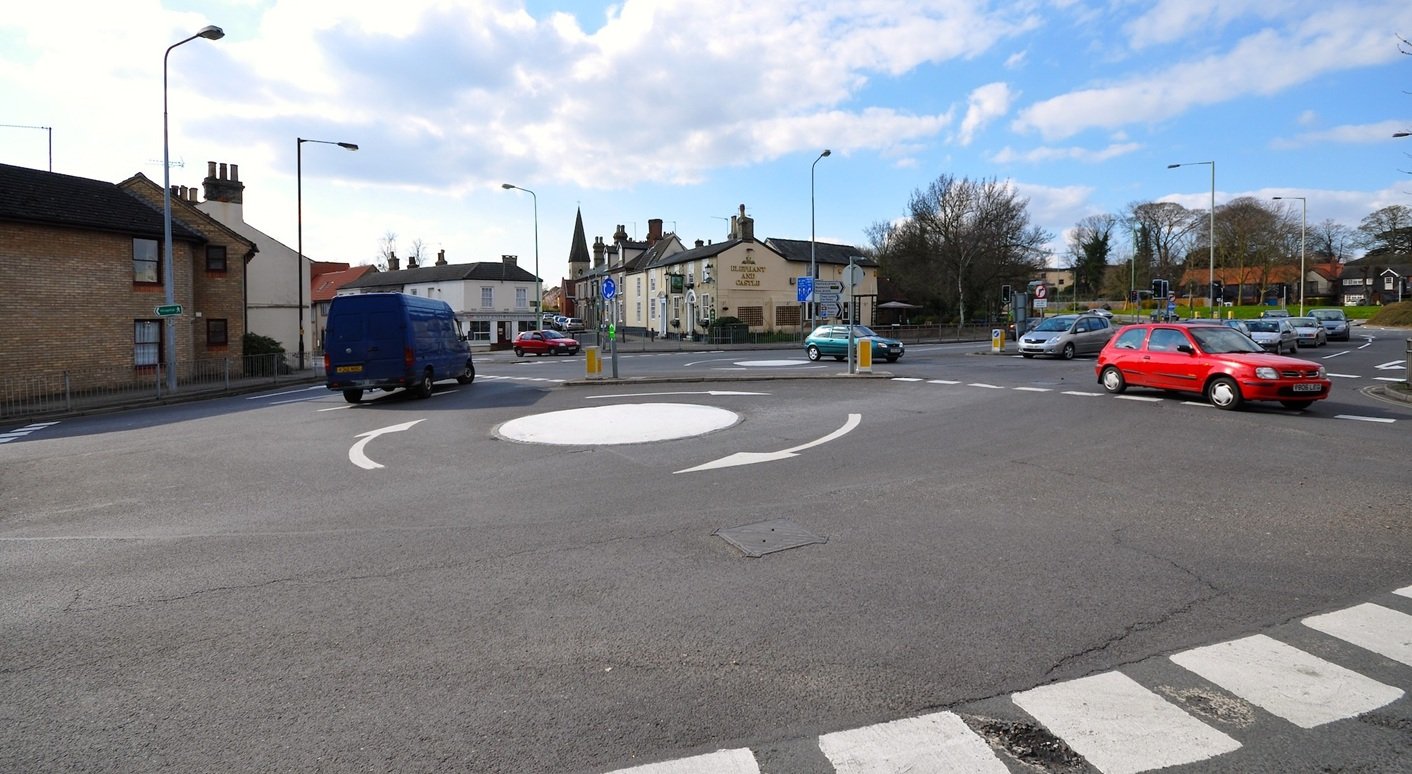
Mini-Roundabouts, Experiments, and the Limits of Early Evidence
Part 3 of 8 | Approximately 11 minutes
Part 2 explained how Britain combined circulating priority with entry deflection and speed-controlling geometry during the 1960s. Together, those changes established the basic operating principles of the modern roundabout.
However, an idea demonstrated under controlled conditions is not yet a standard design. Engineers still needed to determine whether the same principles could work at real intersections with irregular shapes, variable traffic demand, pedestrians, buses, and drivers who had not been briefed in advance.
The next stage therefore moved beyond the question of who should yield. British researchers began testing how much of a conventional roundabout was actually necessary and whether a much smaller circular intersection could operate within the existing footprint of an urban junction.
In This Series
- Before the Modern Roundabout
- The Modern Roundabout Is Born
- From the Laboratory to the Street ← You are here
- Crossing the Atlantic
- How Roundabout Design Evolved
- Designing for People Outside the Vehicle
- How Roundabouts Are Evaluated and Chosen
- Roundabouts Today
In This Part
- Why researchers tested smaller central islands
- How the mini-roundabout developed
- How experiments moved from the test track to public roads
- What happened at the Peterborough experiment
- What Cardiff and Hillingdon revealed
- What the early evidence showed about pedestrians and safety
- How individual experiments became a repeatable design method
Why test a smaller central island?
The conventional roundabout used a central island to separate opposing movements and establish a circulating roadway. The larger the island became, the more clearly it performed that function. A large island, however, also required substantial land and could place the approach entry points far apart.
That created a practical limitation in established towns. Engineers could not always widen an intersection, purchase adjacent property, or construct a grade-separated junction. If modern roundabout principles required a large central island, the treatment would remain unavailable at many of the urban intersections where congestion was most severe.
Frank Blackmore’s 1970 Road Research Laboratory report, Capacity of Single-Level Intersections, describes the effort to obtain more capacity from the area already occupied by an intersection. The research was primarily empirical. Engineers changed the shape of the junction, the width of its entries, the size of the central island, and the method of control, then measured how the different arrangements performed.
The experiments found that reducing the central island of a conventional roundabout could improve capacity, but only to a point. If they reduced the island further without positively deflecting entering traffic, vehicles tended to form what the report describes as a nucleus of congestion near the center. Drivers had difficulty maintaining the priority rule and organizing themselves around the very small island.
Approach entry deflection changed the result. When the approach directed vehicles toward the nearside before they entered circulation, the central island could be reduced much further. The curved entry path assumed part of the island’s former role by separating movements, directing drivers into circulation, and controlling entry speed.
The result was not simply a smaller conventional roundabout. It was a different way of making how each elements of the intersection functions.
The development of the mini-roundabout
The mini-roundabout emerged from this attempt to preserve roundabout operation within a much smaller footprint. Instead of relying on a large raised island, the design used circulating priority, entry alignment, and approach markings and deflection to establish the intended path.
The term has since acquired a more specific engineering meaning. The Federal Highway Administration’s 2010 technical summary describes a mini-roundabout as a small roundabout with traversable central and splitter islands. It is intended primarily for low-speed locations where physical constraints prevent construction of a larger roundabout with a raised central island. Although, it is possible to find mini-roundabouts being built on higher speed roads too by reducing the speed limit in multiple stages on the approaches to the roundabout.
That modern definition should not be applied backward too rigidly to every early experiment. Blackmore’s report documents tests involving several island sizes, positions, and entry layouts. Researchers were still determining which parts of the concept were essential and how small the island could become under different conditions.
Also, the island could not be treated as irrelevant either. A mini-roundabout still had to communicate circular movement clearly. Passenger vehicles were expected to follow the intended path around the center, even if larger vehicles required a traversable area to complete the turn.
This distinguishes a mini-roundabout from a neighborhood traffic-calming circle or a painted circle placed in the middle of an intersection. The FHWA summary specifically treats a mini-roundabout as an intersection form, not merely as a traffic-calming device. It must retain the operating principles of a roundabout, including yield control at the entries, circulating priority, and geometry that manages vehicle paths.
A painted or mountable center does not create those conditions by itself. The entire intersection must reinforce them.
From the test track to public roads
The Road Research Laboratory first tested alternative junction layouts on a full-scale track. According to Blackmore’s report, members of the public responded to advertisements and drove their own cars through the experimental intersections. Buses were included in some of the tests.
Researchers used movable road “furniture” (such as cones, portable barriers and curb sections), signs, markings to change the layout, and instructions for operating rules. They maintained queues on all approaches and counted vehicles leaving the intersection using three independent methods: electronic counting, manual tallies, and film records.

This approach allowed many configurations to be compared within a controlled setting, but the report explicitly recognized its limitations, too. The test intersections were symmetrical, the drivers were briefed and concentrating on the experiment, and pedestrians were absent. Blackmore cautioned that the value of the results was primarily in comparing one arrangement with another, not in treating the measured capacities as values that would necessarily occur on a public roadway.
The next phase tested the design principles at three actual junctions: a three-legged intersection in Peterborough, a four-legged intersection in Hillingdon west of London, and a five-legged intersection in Cardiff.
The general procedure was consistent:
- Observe flow, delay, and saturation before changing the intersection.
- Remove existing islands and movable equipment to create an unobstructed test area.
- Mark alternative layouts using movable equipment and evaluate under traffic.
- Select a preferred layout for permanent installation or further consideration.
This process is important to the history. The mini-roundabout did not move directly from a drawing to nationwide use. Engineers tested alternative geometries under controlled conditions, carried the most promising principles onto public roads, observed how real users responded, and revised the layouts before making them permanent.
Peterborough: more capacity within the same footprint
The Peterborough experiment took place at a three-legged intersection previously controlled by traffic signals. Researchers tested different central-island sizes and positions before selecting a layout with a 3-meter (~10 ft) diameter island within a 29-meter (~95 ft) inscribed circle.
The 1970 report states that the selected arrangement produced a measured capacity of 4,700 passenger-car units per hour, compared with 3,700 under the previous signal control. Average delay fell to less than half of its previous level across the studied traffic conditions. The report estimated that the reduction represented approximately 50,000 vehicle-hours saved annually.

These results were substantial, but they should be interpreted within the purpose and methods of the experiment. Researchers were measuring the maximum discharge from queued approaches, not documenting how every mini-roundabout would perform under ordinary demand. The selected layout also reflected the specific shape, traffic distribution, and available pavement at that intersection.
The experiment nevertheless demonstrated that a roundabout could provide considerably more operational capacity without expanding beyond the existing outer curb line. The improvement came from reorganizing the available space, widening the approach entry, applying circulating priority, and physically controlling the way vehicles entered the intersection.
The preferred layout was made permanent. By the time Blackmore’s report was published, it had been operating for approximately 18 months. Peterborough therefore became more than a successful test of a small island. It demonstrated that the laboratory principles could survive contact with everyday traffic and remain in operation after the temporary experiment ended.
Cardiff and Hillingdon: the site context still mattered
The experiment in Cardiff began with a five-legged roundabout containing an egg-shaped island approximately 30 meters (98 ft) across. Researchers eventually replaced it with a 5-meter (16 ft) island within a 46-meter (151 ft) inscribed circle.
The report recorded a capacity increase of nearly 25%, but the experiment also revealed problems that were less apparent on the test track. Drivers initially appeared reluctant to use the full width of the widened entries. The number and variety of conflicting movements also limited the benefit of the additional space.
These observations showed that pavement width alone did not create usable capacity. Drivers had to understand the intended paths and feel comfortable using the available entry area. More legs and more varied movements also created interactions that a simple symmetrical test could not fully reproduce.
The selected Cardiff arrangement was made permanent and had operated for about 12 months by the time the report was issued.
Hillingdon produced a different result. Researchers tested signal control, several roundabout island sizes, and different entry designs at a four-legged junction on a major radial road. The highest measured capacity came from a (full-seized) roundabout with a 15-meter (49 ft) island within a 46-meter (151 ft) inscribed circle. That configuration provided approximately 35% more capacity than the original layout.
The island was considerably larger than those selected at Peterborough and Cardiff. Blackmore suggested that the difference may have resulted from the entry-deflection design and the wider roads at Hillingdon, but he identified the matter as requiring further study.
The experiments did not prove that every central island should be reduced to the same minimum size. They showed that island size, entry geometry, road width, traffic movements, and driver behavior interacted. The appropriate combination depended on the site.
Hillingdon also did not become a permanent mini-roundabout. The intersection had already been scheduled for conversion to traffic signals, and that work was completed after the experiment. The research therefore compared alternatives without predetermining that the roundabout had to become the final treatment.
What the early evidence showed about pedestrians and safety
The early experiments on public roads resulted in strong operational findings, but the pedestrian and safety evidence was more limited.
Temporary crosswalks (referred to as zebra crossings) were installed during the Peterborough experiment, and one was later made permanent. Some pedestrians initially reported that crossing felt more difficult than it had under signal control. The concern appeared to affect older pedestrians in particular because they now had to select their own gap instead of waiting for a pedestrian signal.


Britain’s first zebra crossing, installed in Slough in 1951. By the time of the Peterborough and Hillingdon experiments, temporary and permanent zebra crossings were being tested as part of the roundabout layout itself, not added afterward. (source: wikimedia)
Analysis of time-lapse film found that average pedestrian travel times were shorter under the roundabout arrangement. The report also stated that pedestrians and drivers were generally satisfied with the operation after several months.
Shorter travel time, however, is not the same as greater safety or comfort. The observation showed that pedestrians could cross more quickly on average, but the initial concerns also demonstrated that a change in control can impose a new decision-making burden even when delay improves.
At Hillingdon, pedestrian volumes were higher and the roads were wider. Refuge islands were placed to reduce conflict between pedestrians and vehicles. Blackmore reported that the pedestrian refuge appeared effective, but the experiment did not provide a detailed before-and-after pedestrian safety evaluation.
The crash evidence was even weaker. Precise before-and-after crash records were not available for Peterborough or Cardiff. Neither site had experienced a high crash rate before conversion, and the local authorities reported no significant change afterward. Blackmore also referred to an earlier five-intersection study that found lower injury risk at roundabouts than at signalized intersections, particularly for pedestrians. That broader comparison supported continued evaluations, but it did not substitute for site-specific safety evidence from the trials.
The defensible conclusion is therefore narrower than the common historical summary. The early experiments demonstrated meaningful capacity and delay improvements. They also showed that entry deflection could control speed and that pedestrian accommodation had to be incorporated into the layout. They did not, by themselves, establish a reliable crash-reduction estimate though.
From individual experiments to a design method
Across the three public-road experiments, the highest-capacity roundabout arrangements produced improvements of approximately 20 to 35 percent within the existing outer curb lines. Blackmore concluded that better use of circulating priority, entry width, and intersection shape could produce substantial operational gains at considerably less cost than conventional widening or grade separation.
The most important result was not a single preferred island diameter. Peterborough performed best with a 3-meter (~10 ft) island, Cardiff with a 5-meter (16 ft) island, and Hillingdon with a 15-meter (~49 ft) island. The experiments showed why a fixed geometric recipe would be unreliable.
Instead, they established a method:
- Observe how the existing intersection operates,
- Test the relationship between priority and geometry,
- Provide enough entry deflection to control speed and clarify circulation,
- Use the available pavement efficiently without assuming that more pavement will automatically improve operation,
- Account for irregular traffic patterns, pedestrians, buses, and other conditions absent from a controlled test, and
- Measure the result before treating the design as successful.
This method helped turn the modern roundabout from a British operating rule into an adaptable intersection form. The central island could be large, compact, or traversable, but priority, speed control, and vehicle paths still had to work together.
That distinction remains important today. A mini-roundabout is not simply a full-size roundabout compressed until it fits. It is also not a painted circle expected to correct driver behavior on its own. Its effectiveness depends on whether the entire layout establishes clear circular movement at an appropriate speed.
By the end of this experimental period, Britain had demonstrated that modern roundabout principles could work at conventional intersections, irregular urban sites, and intersections too constrained for a traditional central island. The next question was whether those principles could cross national borders and overcome the poor reputation left by older traffic circles elsewhere.
That transition was particularly difficult in the United States, where many engineers and drivers believed that roundabouts had already been tried and had failed. The arrival of the modern roundabout in the United States is covered in Part 4.
← Previous: Part 2, The Modern Roundabout Is Born
Next: Part 4, Crossing the Atlantic →
Leave a Reply