
How Pedestrian, Bicycle, and Accessibility Guidance Changed
Part 6 of 8 | Approximately 12 minutes
Part 5 explained how roundabout design became a performance-based process. Designers learned to evaluate vehicle speeds, lane alignment, truck movements, and the interaction between geometric elements instead of relying on a standard diameter or layout.
That refinement also exposed a broader design problem. A roundabout could control vehicle speed and operate efficiently but still be difficult to cross or navigate for other types of road users: people outside motor vehicles.
Pedestrians had to find the intended crossing, judge approaching traffic, and move across entry and exit lanes without the protected phase provided by a conventional traffic signal. Bicyclists needed a clear choice between circulating with motor vehicles and using a separate path. People with vision impairments needed enough non-visual information to locate the crosswalk, identify the direction of travel, and determine when it was appropriate to cross.
Guidance gradually began treating pedestrians, bicyclists, and accessibility performance as part of the basic roundabout design.
In This Series
- Before the Modern Roundabout
- The Modern Roundabout Is Born
- From the Laboratory to the Street
- Crossing the Atlantic
- How Roundabout Design Evolved
- Designing for People Outside the Vehicle ← You are here
- How Roundabouts Are Evaluated and Chosen
- Roundabouts Today
In This Part
- Why early roundabout research concentrated on vehicle operation
- Why pedestrian crossings moved away from the circulatory roadway
- How splitter islands created a two-stage crossing
- Why multilane crossings introduced a different yielding problem
- How bicyclists were given two ways through the intersection
- Why roundabouts created particular challenges for people with vision disabilities
- How accessibility became a defined design requirement
Early research concentrated on vehicle operation
The British experiments described in Part 3 examined pedestrian movement, but their strongest findings concerned capacity, delay, priority, and geometric design. The controlled test-track experiments did not include pedestrians, and the public-road trials provided only limited pedestrian observations.
This focus stemmed from the problem researchers were initially trying to solve. Circular intersections were prone to locking under traffic, required excessive land, and operated with inconsistent priority. The early modern roundabout was developed primarily as a different way of organizing vehicle movement.
Pedestrian accommodation was present, but it was not yet supported by the detailed performance checks that later guidance would provide. At Peterborough, for example, temporary zebra crossings were installed during the public-road experiment. Film analysis showed that average pedestrian travel times were shorter under the roundabout arrangement, but some pedestrians initially reported greater difficulty choosing their own crossing gaps. The early result was therefore mixed. The roundabout could reduce pedestrian delay, but removing a traffic signal also transferred part of the crossing decision from the signal indication to the pedestrian.
As roundabouts spread into American practice, this distinction became more important. A pedestrian at a signalized intersection may receive a defined walk interval. A pedestrian at an unsignalized roundabout crossing generally depends on an acceptable gap or on approaching drivers yielding.
The geometric design could make that task easier by reducing vehicle speed, shortening the crossing, and staging the crossing maneuver to be separate for each direction of vehicular traffic. It could not eliminate the crossing decision entirely.
Pedestrian crossings move away from the circulatory roadway
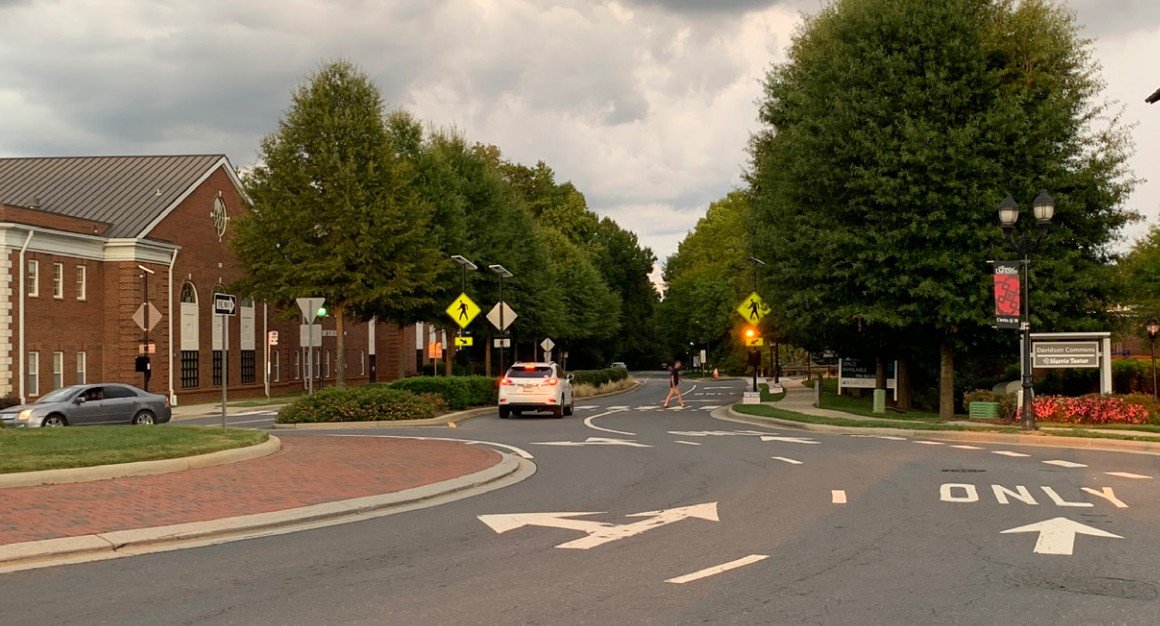
Pedestrian access at a modern roundabout is generally provided across the approach and departure legs, not across the circulatory roadway to the central island.

The FHWA’s 2000 guide described pedestrian crossings around the perimeter of the roundabout and recommended to discourage pedestrians from traveling to the central island. The central island organizes vehicle circulation and is not intended to function like a conventional street-corner refuge.
Placing the crosswalk directly beside the circulatory roadway also creates competing demands on drivers. An entering driver may need to observe a pedestrian, vehicles circulating from the left, the vehicle immediately ahead, and the yield line within a very short distance.
Moving the crossing back from the circulatory roadway separates some of those decisions. The entering driver encounters the pedestrian crossing before reaching the vehicle yield line. A vehicle exiting the roundabout also has space to complete part of the exit movement before reaching the crosswalk. In other words, the setback provides these benefits:
- It can shorten the crossing compared with a location adjacent to the inscribed circle.
- It separates pedestrian conflicts from the points where entering and circulating vehicles interact.
- It can provide storage for a vehicle between the crosswalk and the yield line.
- It allows the crossing to pass through the splitter island.
The setback also creates tradeoffs. Moving the crosswalk farther from the intersection increases travel for pedestrians that is out of their direction. A crossing placed too far downstream on an exit may also encounter accelerating vehicles .
Current guidance therefore treats the correct location as a relationship among vehicle speed, expected queues, crossing distance, sight lines, pedestrian routes, and the ability of drivers to recognize and respond to the crosswalk.
The 2023 Guide for Roundabouts retains the basic principle of locating the pedestrian crossing back from the circulatory entrance. The design objective is to place the crossing where approaching drivers and bicyclists can direct their attention toward it without producing unnecessary pedestrian travel or exposing the crossing to excessive exit speed.
Splitter islands create a two-stage crossing
The splitter island originally helped establish vehicle deflection, separate entering and exiting traffic, and make the roundabout visible on the approach. It also became the element that divided the pedestrian crossing into two parts.
Instead of crossing both directions of traffic at once, a pedestrian can cross the entry lanes, pause within the splitter island, and then cross the exit lanes. The sequence can also occur in the opposite order depending on the pedestrian’s direction of travel.
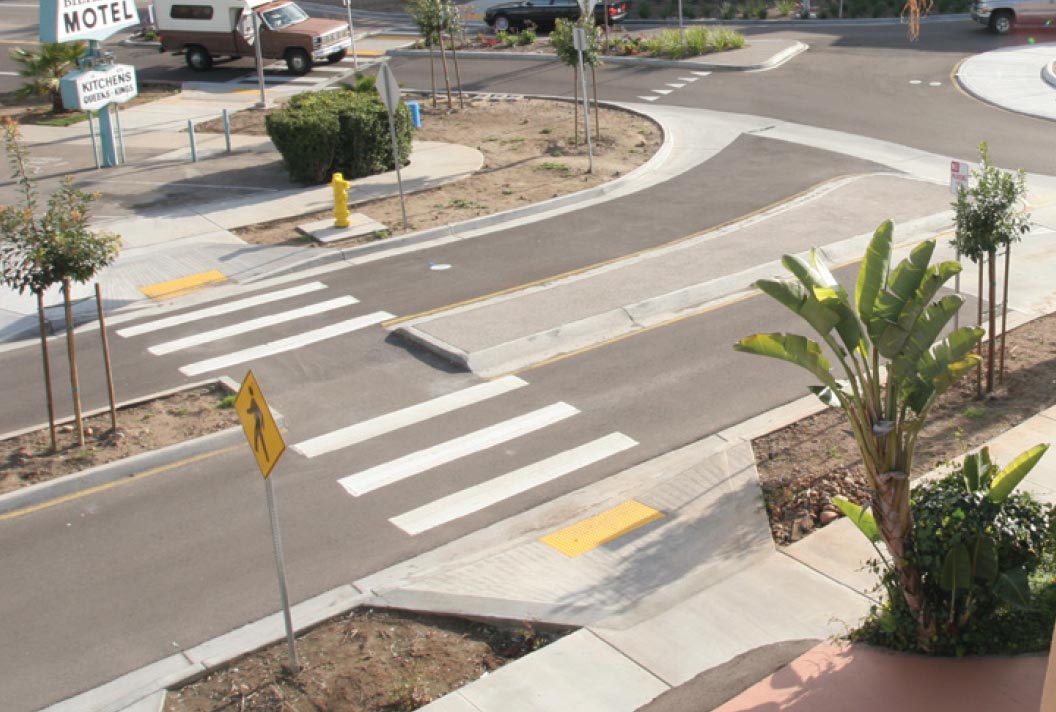
This arrangement simplifies the traffic observation task. On each half of the crossing, vehicles approach primarily from one direction. The pedestrian can evaluate the entry and exit movements separately instead of identifying a gap across the complete roadway at one time.
The refuge is particularly useful for pedestrians who move slowly or need additional time to confirm that the second half of the crossing is clear. It also reduces the amount of roadway exposure during any one stage.
However, placing an opening in a splitter island does not automatically create a usable refuge. The island must provide adequate clear space for pedestrians using wheelchairs, mobility devices, strollers, or bicycles. The surfaces and transitions must be traversable, and the two sides of the crossing must be aligned clearly to establish the intended direction of travel.
Detectable warning surfaces identify the transition between the pedestrian space and the roadway for people who cannot rely on visual contrast. The U.S. Access Board’s public-right-of-way accessibility guidelines (PROWAG) address the clear width of pedestrian access routes through refuge islands and the placement of detectable warning surfaces at cut-through openings.
The refuge also has to function under actual traffic conditions. If a splitter island is too narrow, a pedestrian may be physically close to moving vehicles on both sides. If its shape directs the pedestrian diagonally or fails to provide a clear waiting area, the theoretical two-stage crossing may not work as intended.
The design question is therefore whether the island provides a recognizable, accessible, and adequately protected place for the vulnerable road users to complete the crossing in two separate decisions.
Multilane crossings change the yielding problem
A single-lane roundabout crossing usually requires the pedestrian to determine whether one approaching driver has yielded or whether one lane contains an acceptable gap. A multilane crossing adds another decision.
One driver may stop for a pedestrian while a driver in an adjacent lane continues moving. The stopped vehicle can partially block the second driver’s view of the pedestrian and block the pedestrian’s view of the second vehicle. This is commonly described as a multiple-threat condition.
The problem is not unique to roundabouts, but roundabout geometry changes where and how it occurs. At an entry, drivers may be concentrating on circulating traffic as they approach the yield line. At an exit, drivers are transitioning from the circulatory roadway, steering toward the departure leg, and potentially accelerating.
A marked crosswalk alone does not resolve these interactions. The designer must consider:
- The number of lanes crossed during each stage
- Vehicle speed at the crosswalk
- Whether one stopped vehicle can obstruct sight lines
- Driver yielding behavior
- Pedestrian demand and crossing delay
- Lighting and nighttime visibility
- The distance between the crosswalk and the vehicle yield line
- Whether an additional traffic control treatment is needed
Possible treatments include geometric speed control such as raised crossings, warning signs, improved illumination, rectangular rapid-flashing beacons (RRFB), pedestrian hybrid beacons (PHB), or traffic signals with pedestrian indications. These devices do not have identical functions, and selecting one requires an evaluation of the site rather than an assumption that every multilane roundabout should receive the same treatment.
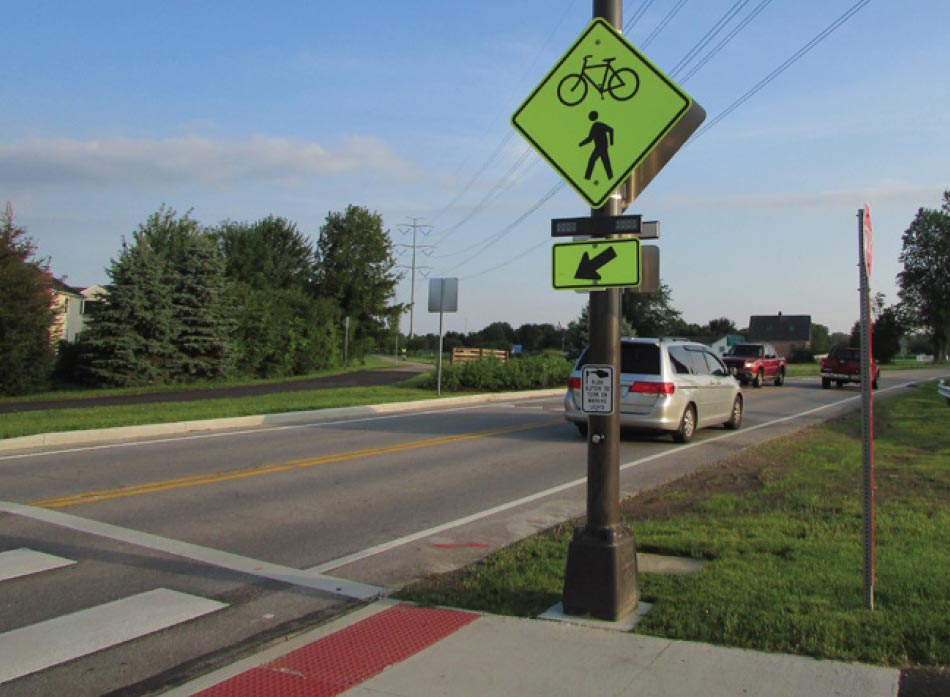
The regulatory discussion also changed over time. Earlier proposed accessibility guidance emphasized pedestrian-activated signals at multilane roundabout crossings. The Access Board’s final 2023 guidelines provide a wider set of options. Under Section R306.4.2, each multilane roundabout segment containing a crosswalk is to receive one or more of four treatments: a traffic control signal with a pedestrian signal head, a PHB, a pedestrian-actuated RRFB, or a raised crossing.
The technical requirement reflects an important development in roundabout history. Multilane pedestrian crossings were no longer treated as scaled-up versions of single-lane crossings. Their visibility and yielding problems required a separate design response.
Bicyclists are given two ways through the intersection
Bicyclists do not form one uniform group. Some are comfortable merging into low-speed traffic and occupying a travel lane. Others prefer physical separation from motor vehicles, especially at multilane roundabouts or locations with higher traffic volumes. Roundabout guidance has developed two general paths for bicyclists.
The first path treats the bicyclist as a vehicle. The bicyclist merges into the travel lane before the roundabout, occupies the lane through the entry and circulatory roadway, and exits with motor traffic.
This path can work well at a low-speed single-lane roundabout because a bicyclist and motor vehicle follow approximately the same line through the intersection. Occupying the lane also makes the bicyclist more visible than riding along the outside edge of the circulating roadway.
The second path moves the bicyclist out of the roadway before the roundabout. A ramp or transition connects the bicycle facility to a shared-use path or other separated route around the perimeter. The bicyclist then continues their travel outside the circulatory roadway before using another transition to reenter the bicycle facility.

The FHWA’s original national guide warned against continuing a bicycle lane around the outer edge of the circulatory roadway. A bicyclist traveling in that position would travel directly across the path of vehicles exiting the roundabout. The outer-edge lane could also suggest that exiting drivers have an unobstructed path when the bicyclist is continuing around the circle.
Ending the bicycle lane before the roundabout allows bicyclists to make a deliberate choice. Those circulating as vehicles need enough distance to merge into the appropriate lane. Those using the separated route need an obvious transition with no abrupt turn or confusion at the pedestrian crossing.
These transitions also affect pedestrians with vision impairments. A bicycle ramp that angles toward a sidewalk can resemble a curb ramp leading to a crosswalk. If the ramp is placed or aligned poorly, it may provide a false wayfinding cue. Bicycle accommodation therefore has to be coordinated with the pedestrian route instead of designed as an independent layer.
The broader network matters as well. A short side path around the circle is of limited value if it does not connect safely to the bicycle facilities before and after the intersection. The design must address how bicyclists approach, choose a path, cross each leg, and continue beyond the roundabout.
Vision impairment reveals an information gap
Much of the information at a roundabout is visual. A sighted pedestrian can observe whether a driver is slowing, identify a hand gesture, watch the position of vehicles in adjacent lanes, and see where the sidewalk leads to the crosswalk.
A person who is blind or has low vision may depend more heavily on traffic sound, detectable surfaces, cane-detectable edges, accessible signals, and consistent alignment.

Roundabouts can make some of those cues more difficult to interpret. Traffic does not come to predictable stops like they do for traffic signals, and a driver only may slow down to yield to pedestrians, to circulating traffic, or in response to other vehicles.
The crossing task for people with vision impairment contains several separate problems:
- Finding the intended crosswalk instead of continuing along the circulatory edge
- Determining the direction in which the crosswalk is aligned
- Identifying the boundary between the sidewalk and roadway
- Determining whether an acceptable gap or yield is available
- Maintaining the intended heading through the crossing
- Locating and using the splitter-island refuge
- Repeating the process for the second half of the crossing
Early American guidance recognized the problem but did not yet have a complete technical response. An FHWA human-factors report published in 2001 recommended additional research into audible signals and other methods of assisting pedestrians with vision disabilities at roundabouts.
That research continued through several National Cooperative Highway Research Program projects. NCHRP Research Report 834, published in 2017, presented a guidebook specifically addressing crossing solutions at roundabouts and channelized turn lanes for pedestrians with vision disabilities.
The guidebook separated the problem into wayfinding and crossing assessments. This distinction was important. A crossing could provide acceptable vehicle gaps but remain inaccessible if a pedestrian could not locate it or align with it. Conversely, clear tactile and geometric wayfinding would not solve a crossing where traffic conditions did not provide usable gaps or reliable yielding.
The research therefore moved the discussion beyond the general statement that roundabouts were difficult for blind pedestrians. It provided a method for identifying which part of the crossing task was failing and selecting a treatment that addressed that particular problem.
Accessibility becomes a design requirement
The development of PROWAG followed a long process. According to the Access Board’s rulemaking history, proposed and interim guidance appeared during the 1990s, a federal advisory committee was established in 1999, draft public right-of-way guidelines were released in 2002 and 2005, and a formal proposed rule followed in 2011.
The final guidelines were issued in 2023. Their application depends on regulations adopted by the federal agencies responsible for enforcing the Americans with Disabilities Act (ADA) and the Architectural Barriers Act (ABA), but their technical provisions define specific accessibility expectations for pedestrian facilities.
For roundabouts, those provisions address more than curb-ramp slopes. They include:
- An accessible pedestrian route through the complete crosswalk and refuge island
- Detectable warning surfaces at roadway transitions
- Detectable separation or edge treatments where pedestrian crossing is not intended
- Adequate clear width through medians and refuge islands
- Accessible pedestrian signals and pushbuttons where signals are used
- Specific treatment options for multilane roundabout crosswalks
The change can also be seen in the 2023 Guide for Roundabouts. The guide places a chapter on user considerations before intersection-control evaluation, safety analysis, operational analysis, and geometric design. The structure of this latest guideline document reflects a performance-based approach. It is expected of designers to identify the people who will use the intersection and the tasks they must complete before selecting and refining the geometry.

For pedestrians and bicyclists, these performance questions focus on whether the intersection provides a clear, safe, and accessible way to navigate and cross. These questions cannot always be answered by adding signs or signals after the roundabout has been designed. Crosswalk setback affects the splitter-island geometry. The refuge width affects the overall footprint. Bicycle transitions affect sidewalk alignment. Edge treatments, curb ramps, detectable surfaces, signal equipment, and drainage all require physical space.
Designing for non-motorist road users therefore became part of establishing the roundabout concept, not an accessory added after vehicle capacity and truck movements had been resolved.
This does not mean that every roundabout requires the same pedestrian or bicycle treatment. A low-volume single-lane roundabout, a multilane urban roundabout, and a rural intersection with few pedestrians present different conditions. Performance-based design requires those differences to be documented and addressed rather than ignored.
Once the needs of different users are identified, an agency must still decide whether a roundabout is the appropriate form of intersection control. That decision involves crash history, predicted safety performance, capacity, delay, queues, cost, right-of-way, environmental effects, and comparison with other alternatives.
How those factors are evaluated is covered in Part 7.
← Previous: Part 5, How Roundabout Design Evolved
Next: Part 7, How Roundabouts Are Evaluated and Chosen →
Leave a Reply