
Part 1 of 5 | Approximately 9 minutes
Traffic control began long before the familiar red-yellow-green traffic light. This first part follows the transition from police officers using gestures and whistles to semaphore devices, early electric signals, and the first three-color systems. It also examines the distinct contributions of John Peake Knight, Lester Wire, James Hoge, William Potts, and Garrett Morgan. The central point is that the modern traffic signal was not invented at one moment by one person. It emerged through several different solutions to related traffic-control problems.
In This Series
- Before the Modern Traffic Signal ← You are here
- From Isolated Signals to a National System
- The Signal Becomes Responsive and Networked
- Expanding Whom and What the Signal Serves
- The Modern Signal and Its Future
In This Part
- Managing Conflict by Hand London
- 1868: The First Major Road-Signal Experiment
- The Automobile Changes the Scale of the Problem
- Why Yellow Mattered: William Potts and the Three-Color Signal
- Garrett Morgan: An Important Patent, Often Misdescribed
- There Was No Single Moment of Invention
Managing Conflict by Hand
Long before automobiles, streets carried pedestrians, horses, carriages, streetcars, bicycles, and other users whose paths crossed at the same locations. So, the underlying problem existed even before then. When the volume and complexity became too great for informal negotiation, police officers were assigned to intersections to allocate right of way. Officers used hand gestures, whistles, semaphore arms, and locally developed devices to tell one stream to stop and another to proceed. The Henry Ford’s historical collection documents this period of hand and whistle control, and traffic historian Clay McShane explains that early street signals borrowed heavily from railway signaling practice. (The Henry Ford; McShane, 1999)
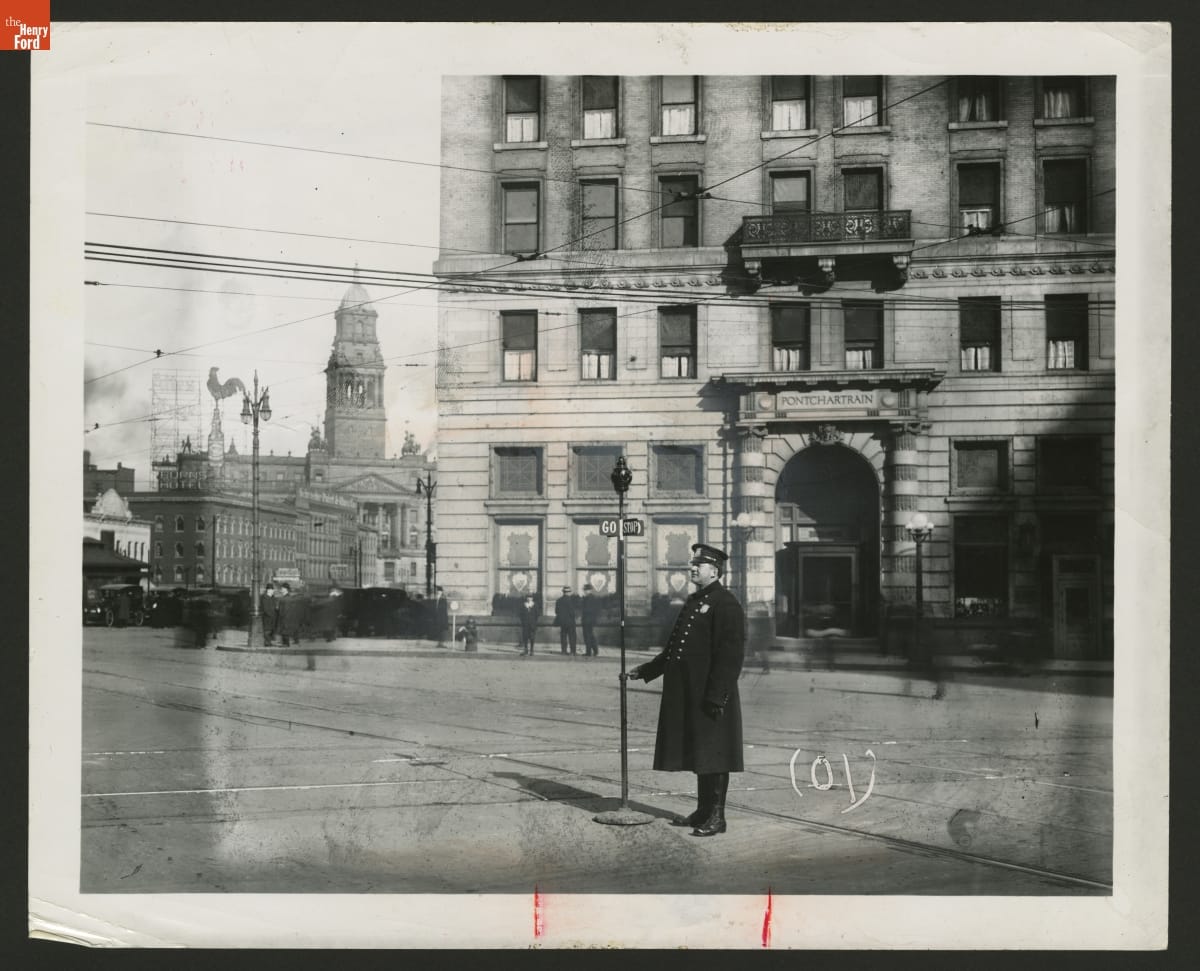
Manual control had advantages. An experienced officer could respond to unusual congestion, give special attention to a streetcar or emergency vehicle, and use judgment when traffic did not fit a fixed schedule. It also had obvious limitations. The work was labor-intensive, officers stood in the middle of traffic and all types of weather, and gestures could differ from one city or officer to another. The officer was simultaneously the detector, controller, display, and enforcer. Early signal technology separated some of those functions, but it did not remove the human operator immediately.
Railways provided a readily available model. Rail systems had already developed visible ways to separate movements and communicate stop, caution, or permission to proceed. Semaphore arms provided a daytime message, and colored lamps provided a nighttime message. Red and green were already established in transportation signaling before road traffic adopted them. McShane traces portions of that color convention through maritime and railway use rather than treating the road signal’s colors as an isolated invention. (McShane, 1999)
London, 1868: The First Major Road-Signal Experiment
The earliest widely recognized road traffic signal was installed outside the Houses of Parliament in London in December 1868. It was proposed by railway engineer John Peake Knight and combined semaphore arms for daytime use with red and green gas illumination at night. A police officer operated the device. It was therefore not automatic, electric, or equivalent to a modern three-color traffic signal. It was better understood as an adaptation of railway signaling to a congested street environment. (History Hit; Washington State University Magazine)

The installation was short-lived. A gas leak caused an explosion, after which the signal was removed. Modern accounts disagree on whether the operating police officer was injured or killed. Sources also differ on whether the signal began operation on the exact date so the defensible wording is that the signal entered service in December 1868, later exploded because of a gas leak, and was removed. The uncertainty on the exact date does not diminish the importance of the experiment, though.
Knight’s device established an important idea: street conflicts could be managed by a standardized external indication rather than by direct negotiation among road users. It also exposed two challenges that would shape later development. A signal needed a safe and reliable energy source, and users needed an indication that was clear enough to obey without an officer personally directing every movement.
The Automobile Changes the Scale of the Problem
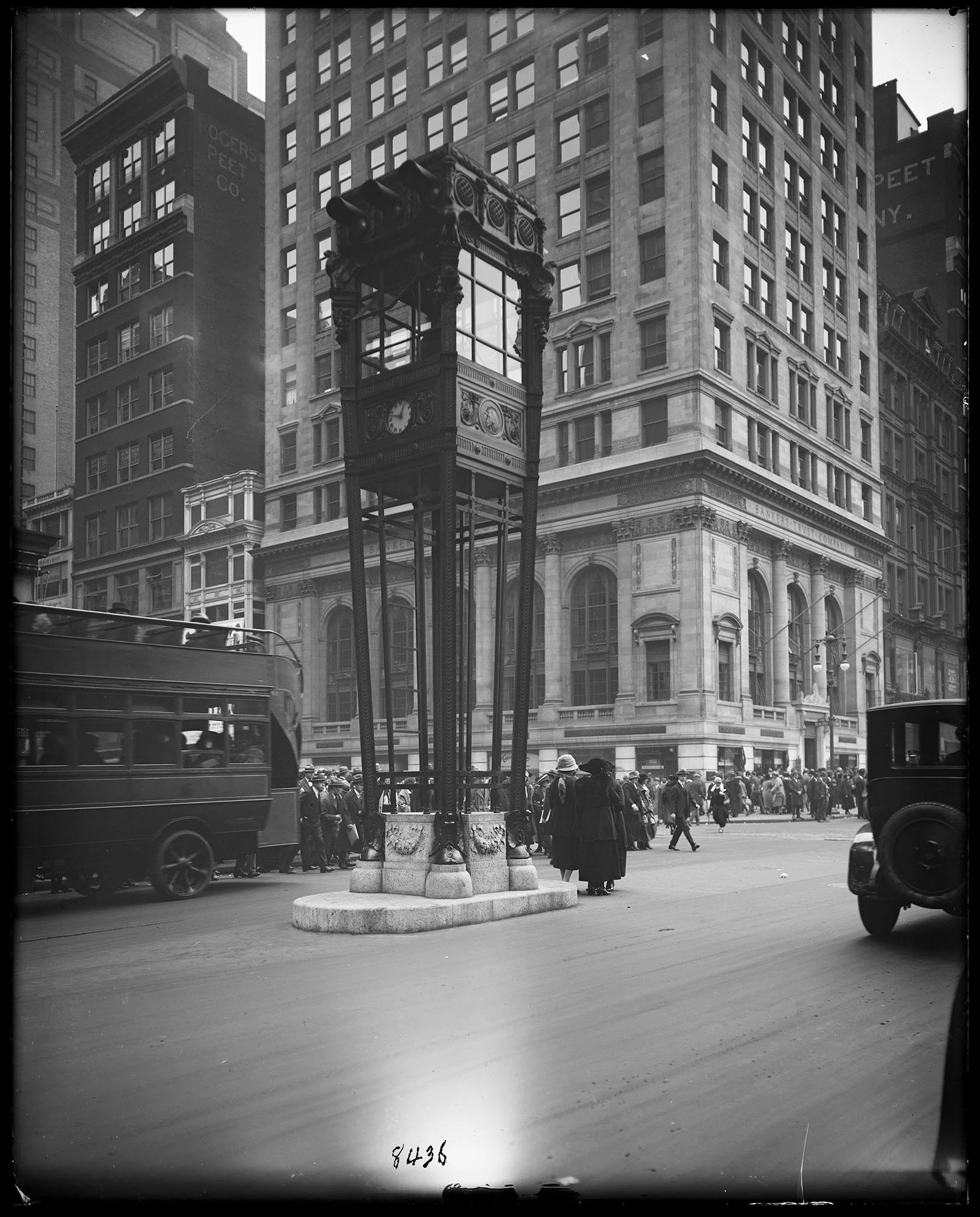
The arrival and rapid growth of the automobile transformed street control from a localized police function into a larger engineering problem. Automobiles moved faster than horse-drawn traffic, accelerated differently, required stopping distance, and mixed unpredictably with streetcars, bicycles, pedestrians, and horses. Early American cities tried traffic towers, manually rotated signs, illuminated words, bells, whistles, and red-green devices. Designs were often local, and the terms “signal,” “traffic light,” “automatic signal,” and “traffic control system” did not always describe the same type of equipment.
This is why the search for the first American electric signal produces several competing answers. Lester Wire, a Salt Lake City police officer, is often credited with an electric red-green device around 1912. The claim is plausible and widely repeated, but McShane found that the permanence and contemporary documentation of the installation were not strong enough to make it an uncontested first. Wire is best described as the creator of an early electric prototype rather than as the documented inventor of the first permanent electric traffic signal. (McShane, 1999)
Here is a story I found online on Lester Wire, and his life, as related to traffic lights.
The strongest official American claim belongs to Cleveland. FHWA’s history identifies 1914 as the year the first electric traffic signal was installed there. The installation at East 105th St and Euclid Ave was based on James B. Hoge’s municipal traffic-control concept. Hoge filed his patent application in 1913 and received U.S. Patent No. 1,251,666 in 1918. His patent described a broader municipal system intended to coordinate street traffic control with police and fire signaling. (FHWA, “The Evolution of the MUTCD”; Hoge patent)
The Cleveland system used red and green indications and an audible warning associated with the change. It was an important step because electric illumination could be seen at night without the hazards of a gas lamp and because the system could be controlled through electrical circuits. It still did not contain the complete visual sequence that modern drivers recognize.

Why Yellow Mattered: William Potts and the Three-Color Signal
A two-color signal has an operational weakness. If a driver sees green and the display changes directly to red, the driver needs some way to know that the assignment of right of way is ending. Earlier systems sometimes used a bell or another warning, but the long-term solution was a visible change interval.
Detroit police officer William L. Potts developed a three-color, four-direction traffic signal in 1920. The Henry Ford has preserved the original device and identifies it as the first tri-color, four-directional traffic signal. Potts added an amber caution indication between green and red, borrowing again from railway practice. The device was installed at Woodward Ave and Fort St in Detroit. The three-color configuration became standard by the mid-1930s. (The Henry Ford artifact record; FHWA history)
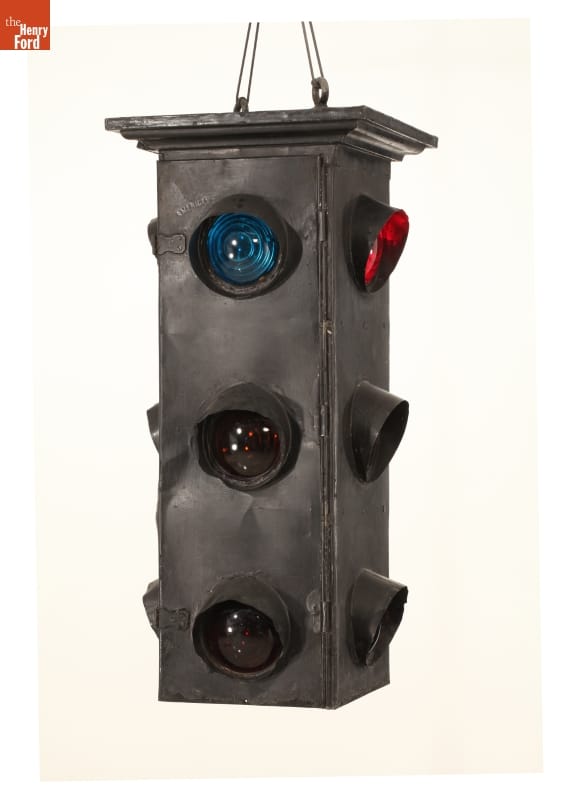
The yellow indication was more than an extra lamp. It created a transition between two incompatible assignments of right of way. In current practice, the yellow change interval warns that the green movement is being terminated and that a red indication will follow. Its duration is critical in traffic safety and its timing decision relates to approach speed, driver perception and reaction, deceleration, and intersection geometry. FHWA’s current Traffic Signal Timing Manual emphasizes that the interval is intended to facilitate the safe transfer of right of way and that its benefit depends on timing consistent with the needs of approaching drivers. (FHWA Traffic Signal Timing Manual, Chapter 1; 11th Edition MUTCD, Part 4)
Potts’s contribution is sometimes obscured by popular accounts that give Garrett Morgan credit for inventing either the traffic light or the yellow light. Morgan’s actual contribution was different and important in its own right.
Garrett Morgan: An Important Patent, Often Misdescribed
Garrett A. Morgan received a U.S. Patent on November 20, 1923, for a traffic signal. The patent is the primary evidence of what Morgan actually designed. It describes a manually operated signal that controlled conflicting traffic movements and included an intermediate all-stop setting. This setting stopped traffic in every direction before traffic from another direction was permitted to proceed. (Morgan patent)
The patent does not describe the modern automatic red-yellow-green display, and it does not establish Morgan as the inventor of the first electric signal or the yellow indication. FHWA appropriately describes his work as a three-position traffic-signal patent rather than attributing the entire traffic light to him. (FHWA, “Safer Stop and Go”)
A three-position traffic signal is a signal that can be placed in three different operating settings:
- Traffic on one street proceeds while traffic on the intersecting street stops.
- The permitted and stopped movements are reversed.
- Traffic in all directions stops temporarily before the right-of-way changes
Morgan’s place in the history should neither be inflated nor minimized. He developed and patented a specific method for introducing a transitional state into intersection control at a time when cities were trying to manage increasingly dangerous conflicts. The patent illustrates the wider recognition that a safe signal could not merely alternate abruptly between “stop” and “go.” It needed a controlled transition.
There Was No Single Moment of Invention
By the early 1920s, several components of the modern traffic signal existed, but they came from different people and places. Knight had demonstrated street semaphore control with colored nighttime indications. Wire represented an early electric prototype claim. Hoge developed a documented municipal electric-control system associated with the 1914 Cleveland installation. Potts created the documented three-color, four-way signal. Morgan patented a distinct three-position manually operated arrangement with an all-stop interval.
New York, Detroit, Cleveland, Salt Lake City, Los Angeles, and other cities also developed traffic towers and interconnected devices or coordinated installations. The answer to “Who invented the traffic signal?” therefore depends on the question being asked. Does “first” mean the first road semaphore, the first electric prototype, the first permanent electric installation, the first automatic control, the first three-color display, the first four-way signal, the first patented three-position arrangement, or the first coordinated system?
McShane’s historical analysis is especially valuable because it resists turning a distributed technical evolution into a single-inventor story. Temporary installations, undocumented prototypes, patents, permanent municipal systems, and commercially deployed equipment are different forms of evidence. The modern signal emerged through accumulation and standardization rather than through one complete invention. (McShane, 1999)
By the early 1920s, several components of the modern traffic signal had emerged, but traffic-control devices and practices still varied considerably among cities. Part 2 examines how signals expanded beyond individual intersections through coordination and how national standardization, particularly through the MUTCD, created a more consistent system.
Leave a Reply