
Part 5 of 5 | Approximately 12 minutes
Today’s traffic signal is more than a roadside display. It is part of a data-driven system involving detection, communications, software, performance monitoring, and continuing agency management. This final part examines adaptive control and automated performance measures, then considers how signal warrants and Safe System principles influence installation decisions. It concludes with connected-vehicle technology, artificial intelligence, and the responsibilities public agencies retain as signal systems become more capable and complex.
In This Series
- Before the Modern Traffic Signal
- From Isolated Signals to a National System
- The Signal Becomes Responsive and Networked
- Expanding Whom and What the Signal Serves
- The Modern Signal and Its Future ← You are here
In This Part
- Adaptive Control: Timing That Responds to Changing Conditions
- Measuring What the Signal Actually Does
- Why Signal Warrants Were Created
- Meeting a Warrant Does Not Require a Signal
- Safe System Thinking Changes the Question
- Connected Signals and V2X
- Will Artificial Intelligence Replace the Traffic Signal?
- The Present-Day Signal Is an Institution as Much as a Device
- Conclusion
Adaptive Control: Timing That Responds to Changing Conditions
Conventional coordination normally relies on stored timing plans developed for representative conditions. Operators can schedule different plans by time of day or select them in response to known events. This works well when demand follows recognizable patterns, but it performs less well when incidents, special events, weather, seasonal changes, or irregular directional flows do not fit the stored plans.
Adaptive signal control uses traffic data to adjust timing dynamically. Depending on the system, it may modify splits, offsets, cycle lengths, phase sequences, or other parameters. FHWA has documented systems including SCOOT, SCATS, OPAC, RHODES, ACS-Lite, InSync, the Los Angeles Adaptive Traffic Control System, UTOPIA/SPOT, and MOTION. That FHWA inventory is useful as a record of documented systems, but it should not be read as a current market-share ranking. (FHWA adaptive-control review)
Adaptive control is sometimes presented as if it eliminates signal timing. It does not. The agency still needs operating objectives, accurate detection, appropriate phasing, pedestrian timing, minimum and maximum timing constraints, transition logic, communications, maintenance, validation, and fallback plans. A system that continuously optimizes the wrong objective can consistently produce the wrong outcome. FHWA emphasizes selecting an adaptive system based on the operational problem to be solved rather than adopting the technology as an end in itself.
This distinction is especially important as vendors use terms such as “smart,” “AI-powered,” or “self-optimizing.” The relevant engineering questions are more specific:
- What data does the system use?
- What variables can it change?
- What objective function or control policy does it apply?
- How does it treat pedestrians, bicycles, transit, side streets, and oversaturated queues?
- What happens when detection or communications fail?
- How will the agency verify that the system improved the outcomes it was purchased to improve?
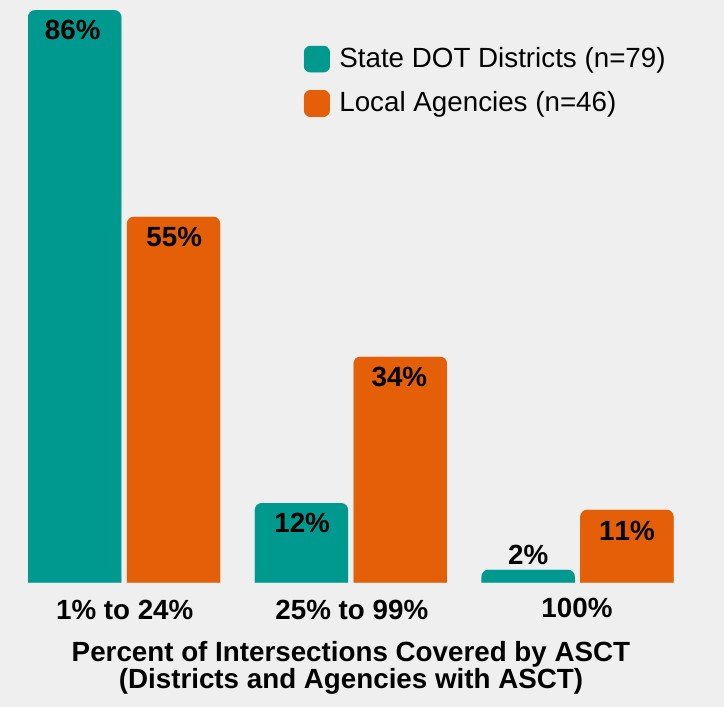
Measuring What the Signal Actually Does
Historically, agencies often evaluated signals through periodic field observations, public complaints, travel-time runs, and occasional retiming projects. High-resolution controller data and automated analysis now allow more continuous measurement.
FHWA defines Automated Traffic Signal Performance Measures (ATSPM) as a suite of performance measures, data-collection methods, and analysis tools supporting performance-based signal operations, maintenance, management, and design. Measures can help agencies examine arrivals on green, split failures, pedestrian and vehicle demand, travel time, detector health, coordination quality, and other outcomes depending on the available data. (FHWA Automated Traffic Signal Performance Measures)
ATSPMs change the management model. Instead of waiting for a complaint or a scheduled retiming cycle, an agency can identify recurring failures, compare conditions before and after a timing change, and prioritize locations based on observed performance. They do not remove the need for field review. Data can be incomplete, a detector can be misconfigured, and a numerical measure can miss a problem experienced by a user who is not adequately detected.
The broader FHWA signal-program framework places performance measures inside an agency management system. Goals and objectives should guide which measures are selected. A corridor optimized only for vehicle travel time may produce a different result from one that also measures pedestrian delay, transit reliability, queue spillback, or equitable access. (FHWA Traffic Signal Program Management)

Why Signal Warrants Were Created
From the beginning of national standardization, engineers recognized that a signal could create problems as well as solve them. The MUTCD therefore developed warrants as threshold conditions under which a signal might be justified.
The current MUTCD states that properly designed, located, operated, and maintained signals can reduce certain crash types, organize traffic, increase capacity under suitable conditions, support coordination, and interrupt heavy traffic so other users can cross. It also warns that improper or unjustified signals can cause excessive delay, encourage disobedience, divert traffic to less suitable routes, and increase some crashes, especially rear-end collisions. (11th Edition MUTCD, Part 4, §4B.02)
Warrants are therefore screening and study criteria, not automatic installation commands. The 1935 MUTCD contained seven pretimed-signal warrants. The structure changed through later editions as traffic operations, pedestrian criteria, research, and control technology developed. The 2000 and 2003 editions contained eight warrants. The 2009 edition added Warrant 9 for an intersection near a grade crossing. The 2023 edition retained nine warrants but revised their status and language, including changes to the crash-experience warrant. (Hawkins, 1992; 2000 MUTCD final rule; 2003 MUTCD Chapter 4C; 2009 MUTCD Chapter 4C)
Under the 11th Edition, the nine warrants address vehicle volumes, peak-hour demand, pedestrian and school crossings, coordinated signal systems, crash experience, roadway networks, and intersections near grade crossings.
Meeting a Warrant Does Not Require a Signal
One of the most persistent public and professional misunderstandings is that satisfying a warrant means an agency must install a signal. The 11th Edition MUTCD states the opposite: “The satisfaction of a traffic signal warrant or warrants shall not in itself require the installation of a traffic control signal.” It also requires an engineering study before a permanent signal is installed and says that the investigation must consider existing safety and operation, the potential for improvement, and the applicable warrant factors. (11th Edition MUTCD, §4C.01)
The manual also directs agencies to consider alternatives. Depending on the problem, those alternatives may include a roundabout, geometric or sight-distance changes, speed reduction, warning devices, turn restrictions, lighting, pedestrian refuge, a pedestrian hybrid beacon, or other treatments. A warrant identifies a condition under which signal control may deserve consideration. It does not prove that signal control is the best available treatment.
The 11th Edition adds another important nuance. FHWA’s Support language explains that an agency can install a signal where no warrant is met if an engineering study documents why the signal is the best solution for improving overall safety or operation. This does not eliminate the study requirement or turn warrants into optional paperwork. It means that warrants are relevant factors but are not intended to be the only or overriding consideration. (11th Edition MUTCD, §4C.01; 2023 final rule)
The practical conclusion is that warrants are neither sufficient nor absolutely necessary under the current national framework. Meeting a warrant is not sufficient by itself and a study is mandatory. A documented no-warrant decision is possible. State or local policy may be more restrictive, so an agency must distinguish the national MUTCD from its own adopted procedures.
Related Tool: Signal Warrants Analysis
I developed a free Signal Warrants Analysis app to help engineers evaluate the current MUTCD warrant criteria and document inputs, assumptions, thresholds, and results. The app supports the warrant-review process, but it does not replace the required engineering study or determine whether a traffic signal should be installed. Here is also a separate note I wrote on developing the app.
Safe System Thinking Changes the Question
Traditional signal evaluation often asked whether observed volumes or crash experience met a threshold. Safe System principles encourage a broader question: how should the intersection be designed and controlled so that predictable human mistakes do not result in death or serious injury?
FHWA’s 2023 final rule explicitly connects the MUTCD to the safety, inclusion, and mobility of all users and to the federal Safe System approach. It also clarifies that the MUTCD governs traffic control devices and does not replace decisions about land use or geometric roadway design. Signals can separate conflicting users in time, but they cannot by themselves correct every problem created by speed, lane configuration, crossing distance, sight distance, access patterns, or surrounding development. (2023 MUTCD final rule)
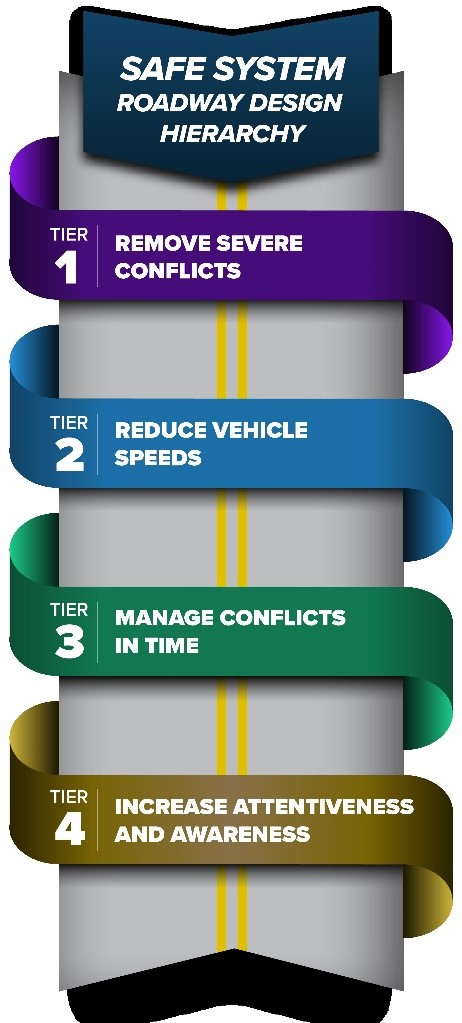
This distinction matters because a signal is often requested as a general response to fear, congestion, speeding, or crashes. A signal may be appropriate, but the underlying problem might be better addressed through geometry, speed management, access control, a roundabout, a pedestrian-specific treatment, or a combination of measures. Signal history repeatedly shows that adding control does not eliminate the need to design the street itself.
The crash-experience warrant presents a particular Safe System tension because it uses prior crashes as part of the justification. Commenters criticized this as reactive. FHWA retained the warrant but revised the crash types and severity treatment and allowed additional analytical methods. Warrants remain useful screening tools, but they are not a complete proactive safety-management framework.
Connected Signals and V2X
The newest stage of signal development extends the intersection beyond roadside detection. Connected-vehicle and vehicle-to-everything systems can exchange messages between vehicles, roadside units, and traffic-management systems.
Two important message concepts are Signal Phase and Timing, or SPaT, and MAP. SPaT communicates the current signal state and timing-related information. MAP describes the intersection geometry and lane-level relationships needed to interpret the signal information. Together, they can support applications such as in-vehicle signal information, transit priority, freight applications, and connected or automated vehicle research.
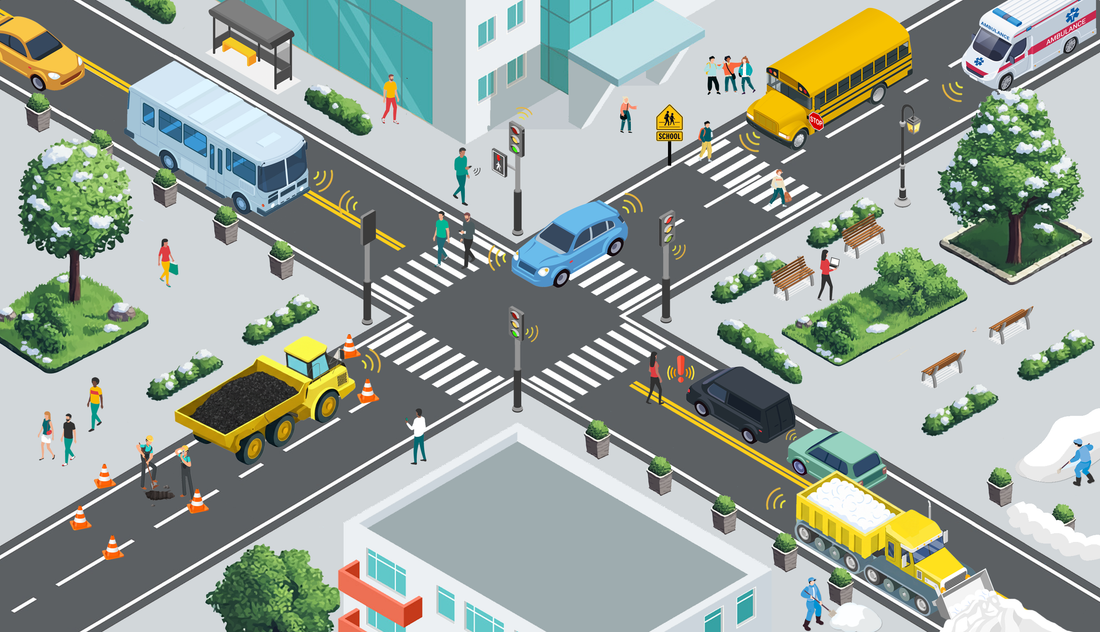
V2X-based transit signal priority can transmit a request and vehicle information directly rather than relying only on a conventional loop, optical detector, or roadside receiver. USDOT documents V2X transit-priority activity as a current deployment area. (USDOT ITS Joint Program Office, V2X Transit Signal Priority)
Connected operation does not make the roadside signal unnecessary. Mixed traffic will contain vehicles with different levels of connectivity for a long period, and pedestrians and bicyclists cannot be assumed to carry compatible devices. The roadside display remains the common public instruction. Connected messages add another communication channel, and that channel must match the field indication and intersection geometry accurately.
Will Artificial Intelligence Replace the Traffic Signal?
Research continues on machine-learning control, connected automated vehicles, trajectory-based optimization, computer vision, and new forms of intersection management. Some concepts imagine autonomous vehicles negotiating crossings with limited reliance on conventional phases. Others use vehicle trajectory data to improve ordinary signal timing. These are legitimate research directions, but they should not be confused with an established replacement for red-yellow-green control.
Several practical constraints remain. The road system serves human-driven vehicles, pedestrians, bicyclists, emergency vehicles, transit, freight, and users with varying abilities. Communications can fail. Sensors can miss or misclassify users. A control policy can optimize the wrong outcome. Public agencies must be able to test and maintain traffic-control systems, review data and decisions, and explain actions. If a system fails or receives unreliable data, it should alert staff and automatically transition to a tested fallback timing plan. This requires appropriate system access, documentation, staff training, maintenance procedures, and clear agency responsibility. The MUTCD’s national uniformity requirements also mean that a new public indication cannot simply be deployed because a model or vendor proposes it.
The defensible near-term direction is more incremental. Signals are gaining richer detection, high-resolution event data, automated performance measures, improved multimodal service, remote management, transit and emergency priority, and connected SPaT/MAP communication. Adaptive algorithms may become more capable, but they still operate within an engineered and regulated system. Claims that artificial intelligence or autonomous vehicles will soon eliminate conventional signals go beyond the verified deployment evidence reviewed for this article.
The Present-Day Signal Is an Institution as Much as a Device
The visible display of today’s traffic signal has remained recognizable since Potts’s three-color signal of 1920, but almost everything behind it has changed. The original sequence has been surrounded by turn arrows, pedestrian symbols, countdowns, accessible indications, bicycle faces, preemption, transit priority, actuated control, adaptive algorithms, central software, performance measures, and connected-vehicle messages.
This continuity can be misleading. A modern signal may look similar to one installed decades ago even though its controller, detection, communication, objectives, and operational capabilities are entirely different. Conversely, an agency can install sophisticated hardware and still provide poor service if it lacks reliable detection, current timing, maintenance resources, clear objectives, or performance monitoring.
The current MUTCD recognizes this lifecycle responsibility. Before installing a signal, the agency must perform an engineering study. The design, phasing, operation, and timing should be based on roadway, traffic, pedestrian, and other conditions. Responsibility for operation and maintenance should be established. Agencies should keep controllers operating as intended, maintain timing records, clean and service equipment, provide for failure operation, and have qualified maintenance personnel available. (11th Edition MUTCD, Part 4)
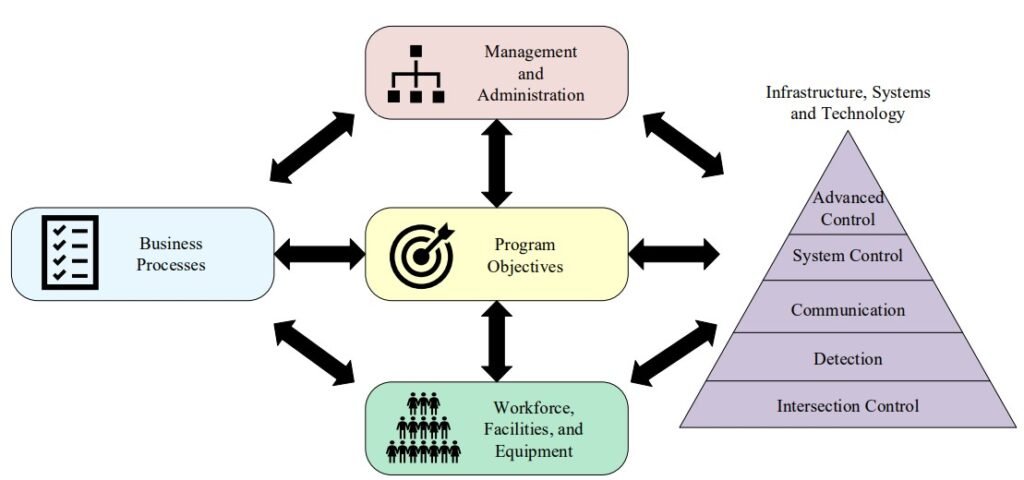
Its purpose is still familiar: to separate conflicting users in time and communicate who may proceed. The difficulty lies in deciding how that time should be allocated, whether the signal is the right treatment, and how the system should be maintained as traffic, technology, and public priorities change.
Conclusion
The most important lesson from that history is that a traffic signal is never only hardware. It is an engineering decision, an allocation of public time, a safety-related control system, and a continuing maintenance obligation. A properly justified and operated signal can organize movement and separate conflicts. An unnecessary or poorly operated signal can create delay, disobedience, diversion, and new crash patterns. The technology has become more capable, but the central question remains the same one that confronted the first traffic officers: how should limited space and time be shared safely among people whose paths cross?
← Previous: Part 4, Expanding Whom and What the Signal Serves
Leave a Reply