
Part 2 of 5 | Approximately 7 minutes
Early traffic signals controlled individual intersections, but installing more signals created a new problem: independently timed devices could repeatedly stop the same traffic. This part examines how engineers began coordinating signals along streets and how increasing travel between jurisdictions made uniform traffic-control practices essential. It also follows the development of the MUTCD from two separate rural and urban manuals into a national standard that continued evolving with signal technology, roadway systems, and the needs of different road users.
In This Series
- Before the Modern Traffic Signal
- From Isolated Signals to a National System ← You are here
- The Signal Becomes Responsive and Networked
- Expanding Whom and What the Signal Serves
- The Modern Signal and Its Future
In This Part
- From an Isolated Device to a Coordinated Street
- Standardization Becomes as Important as Invention
- The MUTCD Evolves with the Signal
From an Isolated Device to a Coordinated Street
Once cities had signals at multiple intersections, another problem appeared. A series of independently timed signals could repeatedly stop the same flow of traffic. Engineers began exploring progressive control, in which neighboring intersections shared a common timing relationship so that a group, or platoon, of vehicles could move along a corridor with fewer stops.
McShane documents proposals for progressive control by 1916 and early coordinated systems during the following decade, including one in Syracuse, NY, by 1925. These systems were limited by the communications and controller technology available at the time, but the governing idea remains familiar. Signals operating on a common cycle can use offsets to control when the green interval begins at each intersection. If those offsets are designed around distance, speed, and traffic patterns, a platoon departing one signal can reach the next during green. (McShane, 1999; FHWA Traffic Signal Timing Manual, Chapter 6)
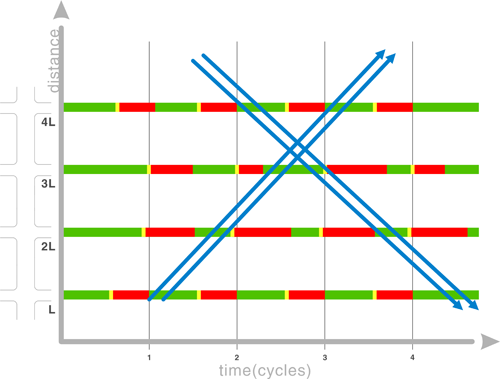
The public often calls this a “green wave,” but the term can create an unrealistic expectation. Coordination does not guarantee that every vehicle will receive green at every intersection. Progression is designed for selected speeds, directions, traffic patterns, and priorities. Favoring one direction can increase delay in another, and a corridor with closely spaced signals, heavy turning traffic, irregular geometry, or oversaturated conditions may not produce a clean progression band.
Coordination also changed how engineers approached signal timing. Instead of treating each signal as an isolated intersection, they began managing groups of signals as a corridor system. A timing decision at one intersection could affect vehicle arrivals, queue formation, and traffic operations at intersections downstream.
Standardization Becomes as Important as Invention
Early signals varied in shape, color, position, wording, and operation. A locally understandable device could become dangerous when drivers traveled into another jurisdiction and encountered an unfamiliar system of indications. The growth of motor travel made uniformity a national safety issue.
During the 1920s, state highway organizations, automobile groups, the American Association of State Highway Officials, and the National Conference on Street and Highway Safety developed competing but increasingly organized standards. Before the MUTCD, traffic-control standards were divided between two national manuals. AASHO’s 1927 manual addressed signs primarily for rural highways, whereas the National Conference’s manual established a broader system of signs, signals, pavement markings, and safety zones for urban streets. Because the manuals were developed separately, their standards were not always consistent. As travel increasingly crossed between rural and urban jurisdictions, maintaining two different systems became impractical.

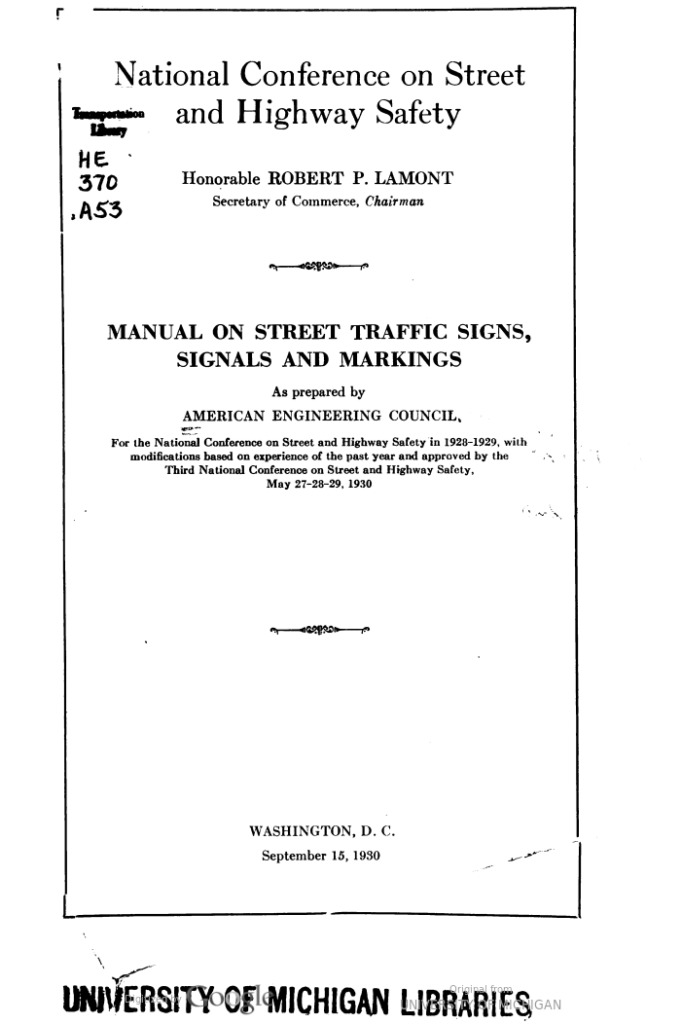
AASHO and the National Conference therefore formed a joint committee in 1932, which issued the first unified Manual on Uniform Traffic Control Devices in 1935. (FHWA history)
The MUTCD clarified the number, color, and meaning of signal indications and adopted the three-color signal as the standard lens arrangement. It also contained seven warrants for pretimed signals: minimum vehicular volume, heavy left turn, minimum pedestrian volume, coordinated movement, through highway, accident hazard, and a combination warrant. These warrants represented an early attempt to move the installation decision from public pressure or local preference toward repeatable engineering criteria. (FHWA history; H. Gene Hawkins Jr., “The Early Editions of the MUTCD”)
Those early criteria eventually developed into the current MUTCD warrant framework. The current criteria can be evaluated using my free Signal Warrants Analysis app

The first MUTCD was approved as an American national standard in November 1935. That should not be confused with the manual’s later federal legal status. Modern federal authority developed after the Highway Safety Act of 1966 authorized national standards for traffic control devices. FHWA became the custodian of the MUTCD with the 1971 edition. Today, 23 CFR § 655.603 recognizes the MUTCD as the national standard for traffic control devices on streets, highways, bikeways, and site roadways open to public travel. States may adopt the national manual, a state manual in substantial conformance, or a state supplement, but state provisions cannot contradict national Standards. (FHWA history; 23 CFR § 655.603)
This progression from local practice to national standardization was one of the decisive changes in signal history. The value of red, yellow, and green depended not only on visibility but also on consistency. A signal became useful at national scale because road users could expect similar indications to carry similar meanings across jurisdictional boundaries.
Georgia provides one example of state implementation. The federal MUTCD allows states to adopt the national manual, a substantially conforming state manual, and supplements or related state materials. The Georgia State Transportation Board voted on June 20, 2024, to adopt the 11th Edition. GDOT’s September 18, 2024, memorandum states that design, construction, maintenance, and operations would transition to the edition and that GDOT standards, drawings, specifications, and guidelines were being updated. Projects with let dates after January 2025 were directed to use the 11th Edition. (GDOT Chief Engineer memorandum)
The MUTCD Evolves with the Signal
The 1935 MUTCD established a unified national standard, but it did not make the traffic-signal practices of that time permanent. Successive editions evolved with advances in technology, expanding roadway systems, and broader expectations for how traffic control should serve different road users (FHWA history):
- The 1939 revision to the 1935 MUTCD addressed signal warrants and pedestrian signals.
- The 1942 “War Emergency Edition” addressed traffic-control practices under wartime blackout conditions.
- The 1948 postwar edition reorganized the manual by consolidating the provisions for each traffic-control device into a single section, making the requirements easier to locate and apply.
- The 1961 edition expanded the manual to address the needs of the Interstate Highway System. The Highway Safety Act of 1966 subsequently authorized the establishment of national traffic-control standards and made compliance with the MUTCD mandatory throughout the United States.
- The completely rewritten 1971 MUTCD formally defined the terms “shall,” “should,” and “may.”
- The 1978 edition added separate parts addressing highway-rail grade crossings and traffic control for bicycle facilities.
- The 1988 edition returned the MUTCD to a bound volume. The previous loose-leaf format had allowed individual pages to be replaced when revisions were issued, but keeping every copy complete, correctly organized, and up to date proved difficult. By the time the 1988 edition was published, the traffic-signal framework contained 11 warrants. (FHWA history; 1984 warrant amendments)
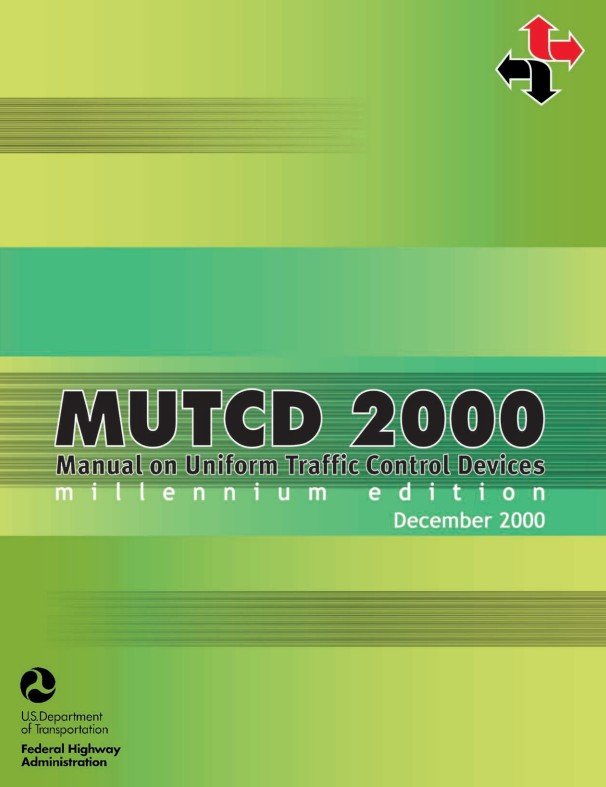
- The 2000 “Millennium Edition” explicitly organized provisions under the headings Standard, Guidance, Option, and Support. It also consolidated and reorganized the previous 11 traffic-signal warrants into eight warrants and added provisions for accessible pedestrian signals. This was the first edition made freely available through FHWA’s website in PDF and HTML formats.
- The 2003 edition retained the same eight-warrant structure and added pedestrian countdown signals. (2003 MUTCD, Chapter 4C)
- The 2009 edition introduced or expanded several signal-related devices, including pedestrian hybrid beacons and flashing yellow arrows, and required the exclusive use of symbolic pedestrian indications rather than word-only WALK and DON’T WALK displays. It also added Warrant 9, Intersection Near a Grade Crossing, establishing the current nine-warrant structure. (2009 MUTCD, Chapter 4C; FHWA history)
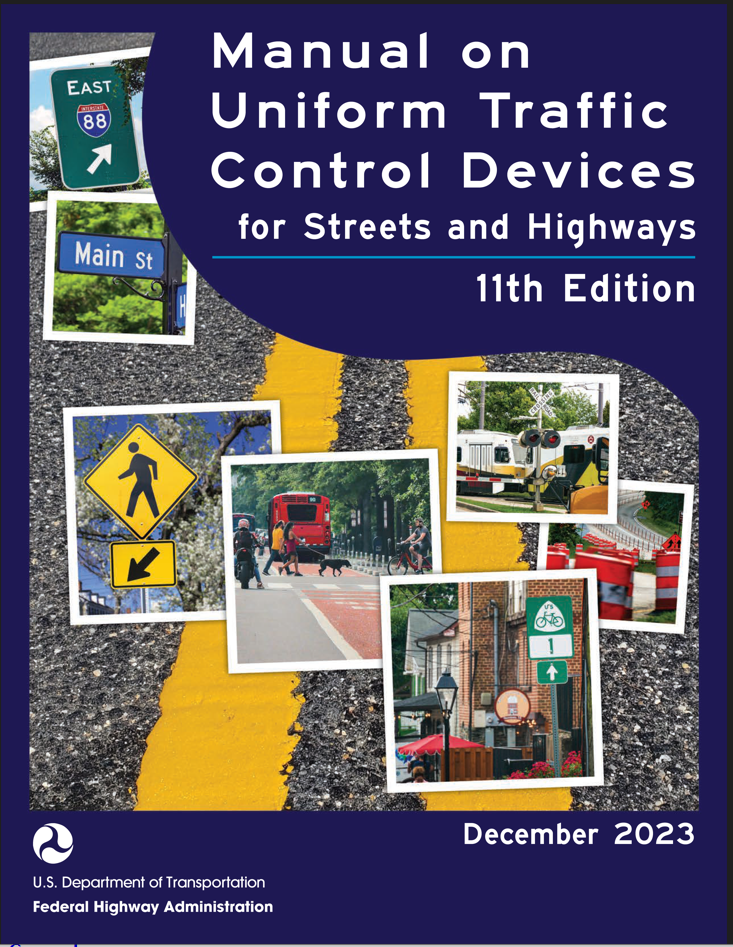
- The 11th Edition, issued in 2023, retained the nine traffic-signal warrants but changed the warrant-application criteria from Standard to Guidance, giving agencies greater flexibility to consider other relevant factors as part of the required engineering study. It also substantially revised Warrant 7, Crash Experience. The edition formally incorporated several treatments that had previously been available through FHWA experiments or interim approvals, including rectangular rapid-flashing beacons and bicycle signal faces. Throughout the manual, FHWA added or strengthened provisions for pedestrians, bicyclists, and people with disabilities and more explicitly connected traffic-control practices to the safety, inclusion, and mobility of all road users. (2023 final rule)
- Revision 1 of the 11th Edition, dated December 2025 and effective March 5, 2026, is the current federal edition as of this article. FHWA describes Revision 1 as a set of technical and editorial corrections that does not change the underlying legal requirements or substantive objectives of the 11th Edition. (FHWA current MUTCD; Revision 1 final rule)
The four MUTCD provision types matter when reading signal requirements. A Standard is mandatory or specifically prohibitive and normally uses “shall.” Guidance is a recommended practice and normally uses “should,” with deviations possible when supported by engineering judgment or study. An Option is permissive and normally uses “may.” Support is explanatory information without a mandate or recommendation. Treating “should” as “shall,” or “may” as “shall,” changes the legal and engineering meaning of the manual. (11th Edition MUTCD, Part 1)
By the end of this period, traffic signals had become nationally standardized and could operate as coordinated corridor systems. However, most still relied on predetermined timing plans that could not respond directly to changing demand. Part 3 examines how vehicle detection, electronic controllers, open controller architectures, and central computer systems made signals more responsive and connected.
← Previous: Part 1, Before the Modern Traffic Signal
Leave a Reply